FORT LAUDERDALE, FL, Feb. 23, 2011 -- The Casa Grande Water Reclamation Facility (WRF) in Arizona had a significant odor problem associated with its headworks operations. The measured hydrogen sulfide (H2S) levels were well above 100 ppm which, according to OSHA (Occupational Safety and Health Administration), is "immediately dangerous to life and health."
The facility had employed a carbon scrubber for their headworks and the preceding diversion box. The plant initially decided to upgrade their older carbon scrubber to a newer bio-scrubber. However, even though the project had already begun, upon learning about Parkson's OHxyPhogg™ in-situ, chemical-free fogging system, the plant immediately shifted gears to include Parkson's technology.
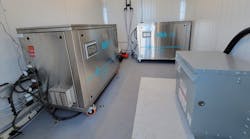
The OHxyPhogg™ was installed at the diversion box, where it treats the odors entering the facility. While this installation has only just begun and more testing will be conducted over the coming weeks, the city found that the H2S levels were reduced by over 50% after just one day. The WRF expects the OHxyPhogg™ to drastically reduce the odors before they enter the new bio-scrubber, thus reducing the plant's costs.
While OHxyPhogg™ systems are often deployed independently, as this installation demonstrates - they have the flexibility to work in conjunction with carbon or bio-scrubbers to save electricity costs and improve the overall effectiveness of the odor control system.
Since the OHxyPhogg™ treats the offensive odors in-situ, Casa Grande saved a considerable amount of money on decreased engineering and permitting fees as well as reduced installation costs given fewer required ducts and blowers.
With over 200 installations in the United States, the OHxyPhogg™ is a proven technology that is self-contained, requiring only minimal electrical power and water to operate. OHxyPhogg™ systems combine ozone, water and air to create a hydroxyl radical fog that is efficiently dispersed throughout confined spaces, such as lift stations, wet wells, holding tanks, and headworks areas. The fog creates a chemical reaction that reduces or eliminates H2S and other odorous compounds. The reaction time is faster than that of chlorine, and the reacted chemistry condenses safely back into the water stream.
For more information on the OHxyPhogg™ odor control technology, please contact a local Parkson Sales Representative or Parkson Corporation at 1-800-553-5419 or [email protected].
###