World of water leg five: Infrastructure and digitization in Africa
Key Highlights
- Many rural communities in Africa lack access to clean water, leading to health crises and increased burdens on women and children.
- Organizations like Surge for Water and Well Aware are leveraging education, technology, and community engagement to promote sustainable water solutions.
- Urban areas like Nairobi face infrastructure challenges due to rapid growth, prompting innovative approaches such as suspended pipelines in Kibera.
- Namibia's Goreangab plant exemplifies successful potable water reuse, demonstrating the potential of green infrastructure in arid environments.
- Digital tools and data collection are transforming water project maintenance and sustainability, reducing failure rates and building community trust.
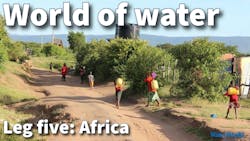
After months spent traveling across Latin America, Europe, Asia and Australia, I finished my year of exploring global water disparities on the African continent visiting Kenya, South Africa and Namibia. For this travel leg more than the others, most of the media I consumed prior to leaving focused on scarcity, inaccessibility and contamination. While there, I undoubtedly witnessed intense water-based challenges, but my conversations with many water experts also revealed bright spots with the potential to illuminate the path to a more equitable and secure future in the African water sector.
Africa water scarcity and rural drinking water access challenges
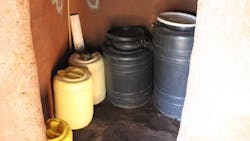
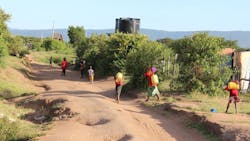
Difficulties in access to clean and safe water are undeniable in many rural settings, where communities can be far from water sources or any form of treatment infrastructure. Despite urbanization, 56% of the total population in Sub-Saharan Africa lives in rural areas. In Kenya, this statistic is closer to 70%, with a lack of piping infrastructure leading UNICEF to estimate that 9.9 million people drink directly from contaminated surface water. I witnessed this myself in a visit to the Masai Mara near the border with Tanzania, where I was invited into the house of a village member. He explained that women and children are sent to collect water from the river near the village, increasing the risk of human-wildlife conflict on the journey and at the point of collection. The water is then stored in the house, where storage drums are often repurposed and uncovered, risking contamination by insects, animals and unwashed hands. Since the river is flowing when collected, village members view the water as clean enough to consume without boiling.
In rural areas of Sub-Saharan Africa, lack of drinking water and sanitation infrastructure go hand in hand with the spread of waterborne illnesses, such as cholera, guinea worm disease, schistosomiasis and typhoid. This is particularly catastrophic for childhood health, as one of the leading causes of death for children under five years of age. In Uganda, diarrhea kills 33 children a day. There and in countless other geographies, the responsibility for collecting water, treating it, teaching sanitation habits and caring for sick children falls on women. This is a great burden of time, energy and resources. In a café in Indonesia, I had the chance to meet with Shilpa Alva, founder and executive director of Surge for Water, who explained how her organization works with local partners in Haiti, Uganda and Indonesia to aid communities in meeting their water and sanitation infrastructure needs, while also offering educational programs centered around women’s health and prosperity. Along with supplying and installing water taps, toilets, and handwashing stations, Surge for Water and its partners contemplate how access to clean and safe water can unlock the next level of economic development and social progress. Think: How can women who previously spent hours collecting water utilize their newfound time and opportunity?
Alva explained that one of their programs focuses on a simple sanitation tool that is often inaccessible in rural communities: soap. UNICEF estimates that only 8% of Ugandan mothers with children under five have readily available soap and water to wash their hands. Since 2021, Surge for Water and its partner Soapbox have produced and distributed over one million bars of soap and educated over 6,000 people in soap-making across Uganda and Haiti. Not only can handwashing with soap save lives by fighting the spread of waterborne illness, the social enterprises that arise around it can also spur economic growth and independence for women in society. This program demonstrates how investment in local skill building and education can empower communities to realize the full benefits of water and sanitation projects. It is not just about public health and childhood survival rates, but also about the opportunities and quality of life that children will inherit as they age.
Sustainable rural water projects: Moving beyond the “fit-and-forget” model
Despite these success stories, the unfortunate reality in rural settings in East Africa is that some external organizations have entered communities with lofty goals and little follow-through. Whether due to difficult logistics, financing or the prioritization of quantity over longevity, Well Aware is an organization in East Africa aiming to confront this “fit-and-forget” model, where water and sanitation projects quickly fall into disrepair or unuse. When I spoke with Kathryn Bergmann, Well Aware’s director of projects, and Mesret Endale, a project engineer, they cited a World Bank study from 2011 which exposed the reality that, despite thousands of organizations doing work in the region, less than 5% of water projects are visited after they’re constructed, contributing to a failure rate of 60%. The fit-and-forget model not only wastes time and resources, but also community members’ trust in future water and sanitation projects. To confront this, Well Aware leverages the widespread availability of mobile phones and connectivity in communities in East Africa, particularly among community leaders, to drive the long-term sustainability of their water projects. They have developed an application, Well Beyond, to do diagnostic tests on systems, service requests, maintenance checklists and real-time chat support and reporting. The main goal is to offer virtual support and expertise to communities, along with selective in-person aid, to keep infrastructure running, while also collecting data that can drive process improvement and keep investors engaged. Bergmann explained that this digital system enables Well Aware’s lean team to meet the needs of over 140 projects across East Africa, preventing systems from falling into disrepair over fixable issues and bolstering community buy-in. This serves as a proof of concept in how digital enablement can address the limitations in resources that reinforce the fit-and-forget model, while also facilitating the collection of data necessary to create a clearer picture of distinct water realities.
The lack of clarity on how existing systems are meeting community needs is not exclusive to rural settings. For example, Nairobi, Kenya is a primary economic hub in East Africa, yet most communities have insufficient piping infrastructure, intermittent flow, and contaminated water resources. While there, I learned from community members that piped water is only available on certain days of the week from public utilities, driving the households that can to buy water from private sources to fill the gaps in supply. Not only can this pose a financial burden, the inconsistency in water flow creates greater risk for microbial intrusion. The challenges that urban water supplies like Nairobi face are being compounded by rapid urbanization. According to the World Resources Institute, the number of people living in African cities is expected to double by 2050 to 1.5 billion, with over half dwelling in unplanned or informal urban infrastructure. These informal communities often lack household piped water completely, relying on private suppliers, unsafe sources, or central pick-up kiosks with exorbitant pricing. The challenge is dual-pronged, as utilities must confront the current gap in water services, while also preparing for future stressors brought about by urbanization and climate change.
Kibera aerial water pipelines
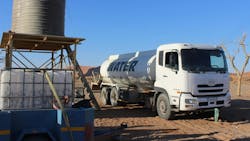
One of the largest informal settlements on the continent houses an estimated 250,000 residents in a 2.5 square kilometer area in heart of Nairobi, called Kibera. Like many informal communities, Kibera lacks clear census data and consistency in urban planning, making it difficult and expensive to lay pipes. One organization, founded by Kennedy Odede, a former Kibera resident, has rethought the traditional structure of piping to better suit informal settlements. Shining Hope for Communities (SHOFCO) launched an aerial pipeline system in 2016, suspending water delivery above the heads of Kibera residents and reducing risk of tampering and contamination. SHOFCO pumps water from boreholes, through filters and into water towers for storage, before sending it through the suspended pipes to kiosks throughout Kibera. The goal is to ensure that nobody in Kibera has to walk more than 8 minutes to the central kiosks. Similar to Surge for Water, SHOFCO is using a drinking water solution as a mechanism for other social initiatives, such as improving the position of women in society through 53 women-led kiosks and implementing health, education and social empowerment programs. So far, SHOFCO’s pipe system has brought water overhead to over 40,000 residents.
Meeting the challenges of urban water today requires re-thinking traditional water systems and investing in innovation. Namibia’s direct potable reuse project, the Goreangab Wastewater Reclamation Plant (GWRP), has allowed the nation to provide water to a growing population in an incredibly dry environment for over 50 years. A new plant was built in 2002 to replace the original facility from 1968, meaning that the GWRP has been turning wastewater into potable water long before it became a popular solution to water scarcity. The capital city, Windhoek, has up to 35% of its water needs met by the plant, amounting to 25,000 kiloliters of drinking water a day. A barrier to adoption in potable reuse has been the “toilet to tap” narrative that fuels the public’s aversion to this solution, no matter how safe the purified water may be. Notably, the GWRP was initially implemented when Namibia was controlled by apartheid-era South Africa, a time where most voices who could have expressed concern were oppressed and censored. The unfortunate reality is that this may have actually helped the GWRP become the first large-scale water reuse plant and led the way in demonstrating to other cities the safety of the technology. Currently, the GWRP is not only an example of effective green infrastructure that tangibly meets growing water needs, but also a source of pride in Namibia.
Global water equity lessons from rural villages to megacities
From rural villages to bustling urban centers, my meetings with drinking water stakeholders in Africa revealed to me the immense innovation and resourcefulness that seeks to confront the significant challenges that many communities face in accessing clean drinking water. Like the other continents I visited, the link between drinking water and sanitation was quite strong. When access to both are established and maintained, drinking water resources are fortified and protected, waterborne illnesses are prevented, and women and children have more time to spend making money and getting an education. A great challenge for many organizations seeking to do productive work in the sector is gaining an understanding of true water realities in rural and remote areas, or even informal settlements within cities. Fortunately, the digital enablement of the water sector in Africa facilitates more effective data collection, along with opportunities for co-development, training, education and longevity in projects.
Ultimately, it is important to recognize in a field ripe with statistics meant to sow either idealism or dread that a great many people are continually working and innovating to solve water challenges, in Africa and around the globe. In my final article, I’d like to thank the more than 100 water experts across 31 countries, from utilities and research institutions to non-profits and community organizations, who took the time to speak with me and educate me on the work they do in the water sector. They have explained with patience the urgency of the global water situation, but have also demonstrated through their technologies, approaches, and innovations the resiliency and determination of our society against our shared challenges.
About the Author
 Kaitlin Spiridellis
Kaitlin Spiridellis
Kaitlin Spiridellis graduated summa cum laude from Vanderbilt University in May 2024, where she studied organizational studies, Spanish, and sustainability. During her time at school, she worked for three years in Vanderbilt’s Drinking Water Justice Lab, where she studied the impact of drinking water contaminants on human body organ systems within community water systems in the United States. She was awarded the Michael B. Keegan Traveling Fellowship in 2024 with a proposal to expand the efforts of the Drinking Water Justice lab globally. Currently, she is traveling across six continents conducting semi-structured conversations and site visits with researchers, NGOs, development firms and municipalities to gain a better understanding of the disparities in how people experience drinking water. She is writing about her experiences on her Substack @spiroadventures and in a column for WaterWorld.