EPA demonstrates emerging technologies for lead service line identification
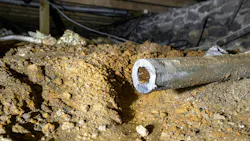
The U.S. Environmental Protection Agency (EPA) hosted its first public demonstration of emerging technologies designed to identify lead service lines with less excavation, lower costs and reduced labor at its Lead Service Line Identification Test Bed in Edison, New Jersey.
Researchers from Dartmouth College and Drexel University demonstrated two approaches for distinguishing lead pipes from non-lead materials. Dartmouth’s electromagnetic induction (EMI) technology uses electromagnetic fields to generate and measure responses from buried metal pipes, helping researchers identify pipe materials without exposing them.
Drexel’s stress wave technology uses mechanical vibrations generated by striking an extension rod connected to an accessible service line valve. Ground sensors capture signals traveling through the pipe and surrounding soil to help distinguish lead from non-lead service lines.
EPA opened the test bed at its Edison Environmental Center in 2025 to evaluate accurate, reliable and minimally invasive identification methods under controlled conditions. The facility provides researchers and businesses with a location to test technologies and demonstrate proof of concept. EPA emphasized that participation does not constitute agency endorsement, recommendation or certification.
More than 97% of water systems have completed their initial service line inventories, according to EPA. The agency said emerging identification technologies could help utilities more efficiently determine the locations of lead service lines as they work to address remaining lead exposure risks.
Under the Safe Drinking Water Act, public water systems must inventory the materials used in their service lines, including identifying those made of lead.