Micro and nanopolymers: What they mean for water treatment operations
Key Highlights
- MNPs include plastics, rubbers, fibers, coatings, and adhesives, all of which are persistent in the environment and can carry harmful contaminants.
- Their small size allows MNPs to pass through treatment barriers, making removal difficult and increasing the risk of contaminant transport, including PFAS, heavy metals, and PPCPs.
- MNPs can chemically degrade, leaching toxic additives like antimony and oligomers, which pose additional health risks to humans and aquatic life.
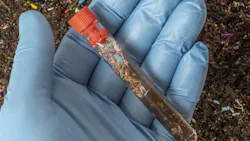
Polymers are all around us, used in electronics, construction, medicine, aerospace, and transportation. Common types include polyethylene (PE), polypropylene (PP), polystyrene (PS), polyvinyl chloride (PVC), polyamides (PA), and polyethylene terephthalate (PET). While polymers provide substantial benefits to modern society, their widespread use has resulted in unintended environmental impacts. Micro- and nanoplastics (MNPs) have emerged as a growing concern for water utilities worldwide, with particles smaller than 5mm (microplastics) and those smaller than 1000 nanometer (nm) (nanoplastics) detected in source waters, treated drinking water, and distribution systems across multiple continents [1].
The term ‘microplastics’ alone, however, does not capture the full range of polymer particles found in water. Many environmentally relevant particles, such as rubbers and elastomers, are synthetic polymers but fall outside traditional definitions of plastics. To better encompass all these materials, we propose using the term micro/nano polymers (which conveniently retains the same acronym, MNPs) to cover particles derived from all polymer, including plastics, rubbers, synthetic fibers, coatings and linings, and adhesives and sealants [2]. This terminology more accurately reflects the diversity of polymer sources in water systems and supports a clearer understanding of their origins, behavior, and potential impacts.
Recent surveys show that tiny MNPs are showing up in water supplies around the world. For water utilities, these aren’t just harmless particles, they pick up and carry other contaminants, acting like a “Trojan horse” through treatment and distribution systems. This makes it harder to remove other pollutants, affects water quality, increases regulatory risks, and puts extra stress on infrastructure. Operators need to learn how MNPs interact with contaminants like PFAS and lead, so they can optimize treatment and ensure water quality for customers. This paper explains these interactions and what they mean for water treatment operations to stay ahead of MNP related issues.

Why MNPs matter to your water system?
Due to the unique morphology and bonding structure, polymers require a long time to degrade, and it has been reported that commonly polymers such as plastics beverage bottles and fishing lines need about 450, and 600 years to degrade, respectively [3]. This persistence in the environment, combined with their small size and widespread distribution, makes MNPs particularly concerning. The toxicity of MNPs includes two major categories: direct toxicity and indirect toxicity.
Direct toxicity primarily arises from the following effects
Size effects (why smaller particles matter more)
Although the health impacts of microplastics are still being studied, smaller particles — especially nanoplastics — are increasingly viewed as higher risk. Their small size allows them to pass more easily through treatment barriers and interact directly with human cells. Recent studies have reported polyethylene nanoparticles in human brain tissue and microplastics in placentas, raising concerns about neurological and developmental effects [4].
Biologically, nanoplastics are much smaller than human cells and interact with cell membranes at the subcellular level. Modeling studies show that particles <10 nm strongly interact with membranes, and particles ≤5 nm disrupt membrane structure and cause cell damage [5]. In practical terms, the smaller the particle, the harder it is to remove and the greater the potential for biological interaction.
Leaching of toxic additives from polymers
As larger plastic materials degrade into micro- and nanopolymer particles, chemical additives leach into water more rapidly because diffusion distances are reduced. Polymers commonly contain additives such as plasticizers, flame retardants, UV stabilizers, antioxidants, pigments, and catalyst residues. Thousands of such additives are used commercially [6], many of which are toxic. For example, polyethylene terephthalate (PET), widely used in beverage bottles, contains antimony (250 ppm) as a catalyst residue [7]. Antimony has an EPA drinking water maximum contaminant level of 6 µg/L, and its release increases as PET degrades into smaller particles. Thus, MNPs represent both a particulate and chemical water quality concern.
Breakdown into smaller, potentially toxic molecules
In addition to forming particles, some polymers chemically degrade into low-molecular-weight compounds such as monomers and oligomers. Certain PET degradation products, such as 1,2- ethylene glycol dibenzoate (EGDB) and 1-(2-hydroxyethyl)-4-methylterephthalate (MHET), are toxic to aquatic organisms or humans at elevated concentrations [8]. For water utilities, this means polymer degradation can introduce dissolved contaminants, not just particles. These compounds may pass through conventional filtration and require different monitoring and treatment approaches.
Indirect toxicity of MNPs
In addition to their own potential toxicity, MNPs create indirect risks by carrying other contaminants. These particles attract and hold pollutants that are already present in water, including heavy metals, PFAS, hydrophobic organic chemicals, microbes, pharmaceuticals and personal care products (PPCPs), and even radionuclides. As a result, MNPs act like mobile carriers, moving these contaminants through treatment processes and distribution systems (Figure 1).
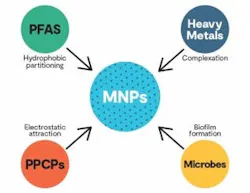
These interactions occur mainly because contaminants stick to or absorb into the polymer particles. Some chemicals attach to the particle surface, while others migrate into the polymer itself. Once attached, these contaminants are harder to remove and lead to inconsistent treatment performance.
How strongly contaminants bind to MNPs depends on the type of polymer, particle size and surface roughness, surface charge, and available surface area. Environmental aging, such as sunlight exposure, oxidation, and disinfection processes change particle surfaces and make them more “sticky.” Common treatment steps like chlorination and ozonation may accelerate these changes. In addition, biofilm growth on particle surfaces further increase their ability to capture contaminants.
Among all co-contaminants, PFAS interactions with MNPs are especially concerning because PFAS are widespread in water systems. PFAS molecules have both water-repelling and water-attracting parts, which allows them to associate with polymer particles. PFAS attachment to MNPs tends to increase for longer-chain PFAS, at lower pH, higher salinity, and on aged or biofilm-covered particles [9].
How MNPs affect water treatment
MNPs, aren’t just tiny particles floating in water, they carry or interact with other contaminants, which cause headaches for treatment processes. They affect everything from coagulation and sedimentation to filtration, oxidation, biological treatment, and even how stable the water is in the distribution system. To stay ahead, it’s important to understand how contaminants stick to MNPs and when they might come off.
PFAS treatment
MNPs make PFAS removal more challenging using conventional treatment technologies such as granular activated carbon (GAC), Ion exchange (IX) resins or membrane filtration, such as reverse osmosis (RO) and nanofiltration (NF) [10]. They slow down treatment, increase stress on equipment, and make it harder to know the true PFAS levels.
- GAC and IX resins: PFAS that’s stuck to MNPs can’t be removed right away. The PFAS has to detach first before the media can grab it. That detachment takes time, and most systems aren’t designed for that delay. If you’re backwashing, you have to be careful — too aggressive, and you stir up PFAS-laden particles and spread them instead of removing them.
- Membrane filtration: RO and NF membranes can block the particles and their PFAS, which is good. But those same particles build up on the membrane surface, which slows flow, fouls the system, and means more frequent cleaning. Plus, PFAS stuck to MNPs act like a slow-release reservoir, suddenly popping back into the water if pH, temperature, or disinfectants change.
- Monitoring: Regular PFAS tests often miss the PFAS stuck to particles because the sample is filtered first. That can make it look like levels are okay when they’re not. Proper monitoring needs methods that measure both dissolved PFAS and particle-bound PFAS — and careful sample handling so you don’t accidentally change what you’re measuring.
Heavy metals
Treating metals gets more complicated and expensive when MNPs are around as MNPs grab heavy metals and carry them through the system.
- Standard processes like coagulation, flocculation, and sedimentation may not remove the metals as efficiently because the particles behave differently than free metals.
- Membranes can filter them out, but fouling happens faster, flow slows, and cleaning becomes more frequent.
- Chemical treatments like oxidation or precipitation might release metals that were stuck to particles if the MNPs aren’t removed first.
- Different types of MNPs interact with metals differently, so one-size-fits-all solutions rarely work.
Pharmaceuticals and personal care products
Pharmaceuticals and personal care products (PPCPs) are another type of emerging contaminant, and they become much harder to remove from water when MNPs are present. Hydrophobic PPCPs including hormones, and antibiotics love to stick to MNPs, making them hard to remove:
- Oxidation processes are less effective because the particles shield the chemicals. You might need more oxidant or more contact time.
- Biological treatment slows down for the same reason — compounds have to detach from the particles first.
- Adsorption media like GAC or biochar face similar issues. MNPs even block pores, reducing how much the media captures.
- Membranes foul faster, and weathered or biofilm-coated particles make chemical release unpredictable, causing spikes downstream.
Management Strategies and Concluding Remarks
MNPs are persistent, widespread, and carry other contaminants like PFAS, heavy metals, and PPCPs through treatment and distribution systems. This makes them a concern not just as particles, but also as carriers of other pollutants. How they behave depends on the type of particle, the contaminant, and water conditions, which means utilities need to be proactive in managing both the particles and their associated risks.
Water utilities can start practical, short-term actions today: identify MNP sources in the plant and incoming water, check treatment performance for particle removal, and spot distribution areas prone to buildup, such as dead ends or low-flow zones. Operators can optimize existing processes by improving coagulation, adjusting filter backwashing, and performing targeted flushing, while maintaining water quality to limit contaminants desorbing from MNPs. Monitoring key locations with particle counts and filter performance, coordinated with PFAS, metals, and PPCP programs, provides early warning and helps guide next steps.
Over the medium term (2–5 years), utilities can use monitoring data to upgrade treatment, pilot advanced technologies, and inspect or replace aging polymer-based components, while ensuring new materials are durable and generate fewer particles. Transparent communication with customers, engagement with regulators, and coordination with upstream dischargers are also critical during this stage.
For long-term planning, MNP management should be fully integrated into treatment design and distribution system renewal. Routine monitoring with defined action levels, combined with workforce and data capacity building, will allow utilities to adapt as science and regulations evolve.
While current treatment can remove many particles, uncertainties remain about when contaminants release, how particle-bound pollutants behave, and the long-term impacts on systems and public health. To manage these risks effectively, utilities will need multi-barrier treatment approaches, enhanced monitoring, and coordinated action with regulators, researchers, and the community. Operators should stay alert to how MNPs affect their systems and think proactively about process adjustments, maintenance, and sampling strategies to ensure safe and reliable water.
Sources
[1] https://www.epa.gov/water-research/microplastics-research
[2] Rodriguez, F., Cohen, C., Ober, C. K., & Archer, L. (2015). Principles of polymer systems, Sixth edition. CRC Press.
[3] Ali Chamas, Hyunjin Moon, Jiajia Zheng, Yang Qiu, Tarnuma Tabassum, Jun Hee Jang, Mahdi Abu-Omar, Susannah L. Scott*, and Sangwon Suh “Degradation Rates of Plastics in the Environment” ACS Sustainable Chemistry & Engineering 2020, 8, 3494-3511.
[4] Nihart, A.J., Garcia, M.A., El Hayek, E. et al. Bioaccumulation of microplastics in decedent human brains. Nat Med 32025, 1, 1114–1119. https://doi.org/10.1038/s41591-024-03453-1.
[5] Limei Xu, Zhenyu Ma, Jingyi Zhu, Zhuo Liu, Yuyang Song, Min Xiao, Jian Li, Xukai Jiang, Lushan Wang “Interaction of polyethylene nanoplastics with the plasma, endoplasmic reticulum, Golgi apparatus, lysosome and endosome membranes: A molecular dynamics study” Ecotoxicology and Environmental Safety 2025, 302, 118680
[6] Naga Raju Maddela, Dhatri Kakarla, Kadiyala Venkateswarlu, Mallavarapu Megharaj “Additives of plastics: Entry into the environment and potential risks to human and ecological health” Journal of Environmental Management 2023, 348, 119364
[7] Westerhoff P, Prapaipong P, Shock E, Hillaireau A. Antimony leaching from polyethylene terephthalate (PET) plastic used for bottled drinking water. Water Res. 2008, 42(3), 551.
[8] Djapovic M, Milivojevic D, Ilic-Tomic T, Lješević M, Nikolaivits E, Topakas E, Maslak V, Nikodinovic-Runic J. Synthesis and characterization of polyethylene terephthalate (PET) precursors and potential degradation products: Toxicity study and application in discovery of novel PETases. Chemosphere. 2021, 275, 130005.
[9] Salawu OA, Olivares CI, Adeleye AS. “Adsorption of PFAS onto secondary microplastics: A mechanistic study” J Hazard Mater. 2024, 470, 134185.
[10] https://www.epa.gov/sciencematters/reducing-pfas-drinking-water-treatment-technologies
About the Author
Zhiyong Xia
Zhiyong Xia is a National PFAS Technical Leader at GHD. He is an experienced scientist specializing in PFAS remediation, water purification, and polymeric materials, with 17 U.S. patents and more than 100 technical publications. Zhiyong has received multiple awards, including the Johns Hopkins APL Invention of the Year Award, and has held scientific and leadership roles at the Johns Hopkins University Applied Physics Laboratory and the Whiting School of Engineering.