RLCore launches reinforcement learning tool for water system optimization
Key Highlights
- RLCore uses reinforcement learning to optimize water treatment processes in real-time, enhancing operational efficiency without hardware replacement.
- The software continuously learns from historical data and adapts to system conditions over time, providing fine-grain control beyond human capabilities.
- Operators retain manual control, ensuring trust and contextual decision-making are preserved within the automated system.
- Targeted applications include chemical dosing, aeration, and pumping, with potential for significant cost savings, especially in energy and chemical expenses.
- Future opportunities for RL include industrial applications in manufacturing, food and beverage, and chemical industries, leveraging continuous data feedback for system optimization.
Decades into the smart water trend, water systems are starting to see the fully realized answers to the reams of operational data they’ve been collecting for years. Solutions providers have developed software with customizable dashboards to interpret that data. They’ve also integrated the data streams of disparate sensors, meters and monitoring devices to feed those dashboards for visibility into system performance.
The marketing of these solutions uses language such as “actionable intelligence” and “making sense out of the noise,” and now the market is witnessing another change that is redefining what that marketing verbiage means. The advent of machine learning and artificial intelligence tools has redefined how data is presented to the executives, managers and operators of water and wastewater systems and the actions they should take based on that data.
RLCore is taking things even further by using a kind of machine learning (ML) called reinforcement learning (RL) to optimize water and wastewater treatment processes in real-time, particularly with high operational cost centers like chemical dosing, pumping, and aeration processes, by filling a space between automation and real-time management.
“We are a deep tech company building software that helps water and wastewater infrastructure become more adaptive,” Ganesh Rao, CEO and co-founder of RLCore, said.
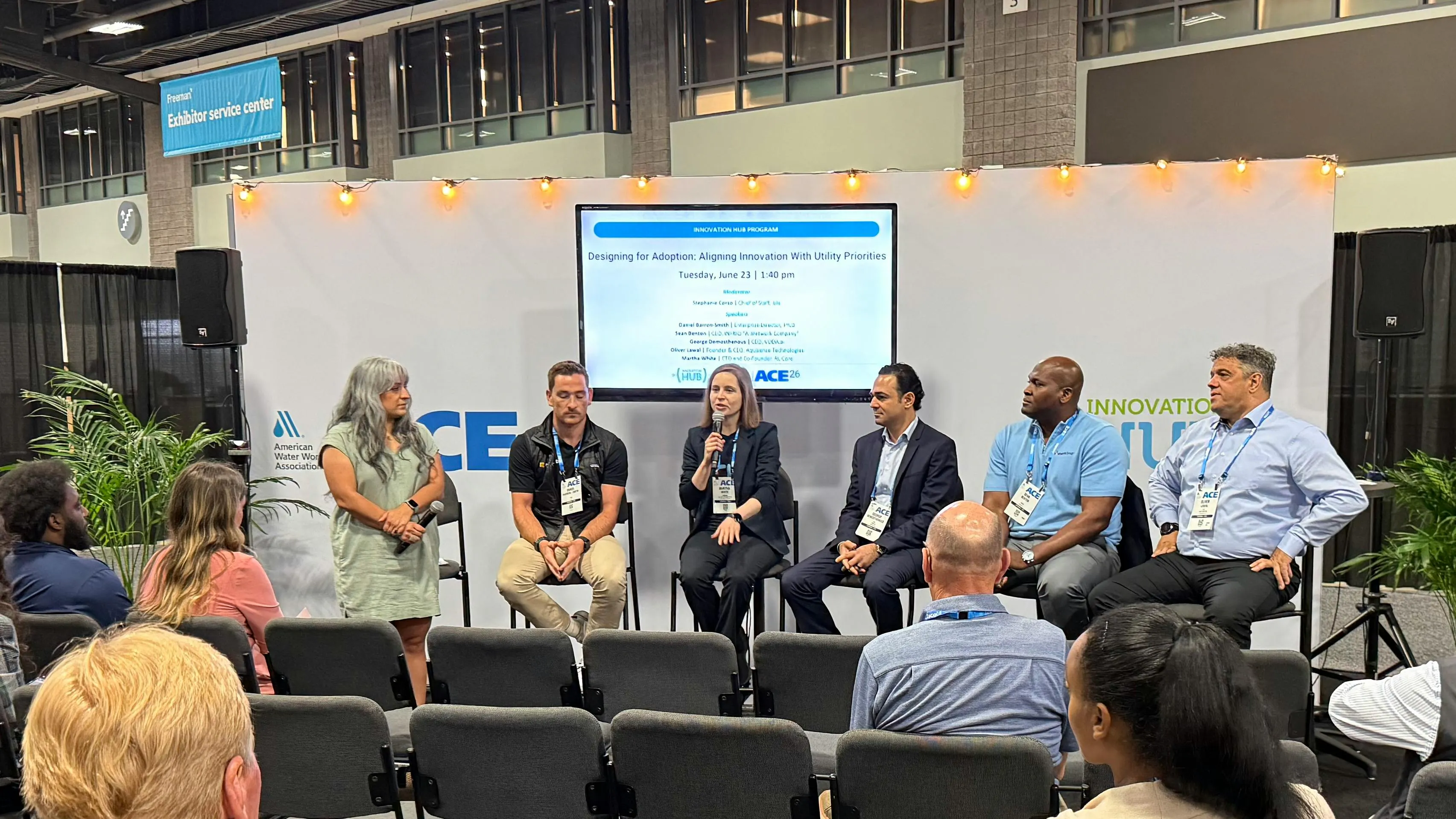
RLCore launched its RLTune technology at AWWA ACE26 in Washington, D.C. This software product sits on top of existing control systems and does not require any replacement of hardware or software to function. It starts by learning from historical data, usually a year or two of operational information, and then continuously adapts to the system as the utility’s sensors relay data back through it so it can review outcomes to improve future adjustments. This data could be chemical dosing, oxygen demand in aeration applications, flow and pressure measurements, or other areas where optimal operations would benefit a water or wastewater system.
Because the machine is reading and optimizing operations, there is a finer degree of operational control. Rao said that even with continuous and deep focus on the data coming in, RLTune can interpret the data beyond human capability. This tool, he said, is designed to assist the operators in plants with more nuanced operational parameters than they would have considered.
“Mathematically, it is hard for humans to do in real time, so that’s where our software is something that continuously works and optimizes in real time,” Rao said.
Augmentation, not replacement
The tool can operate independently and make adjustments to chemical dosing, pump curves, and blower speeds with a frequency that most operators and managers simply don’t have time to do themselves.
RLCore CTO and Co-founder Martha White said RLTune can take that cognitive load of monitoring and optimizing of certain systems off the operator’s mind to free them up for higher functioning tasks. Using historical data, the tool will indirectly learn what the operators were doing and improve beyond their abilities because there is “much more fine-grain control,” she added.
“People can’t sit at a terminal and change a dosing rate every five minutes. They don’t have the time for that,” White said. “They have other things they have to do. So we still like to think of this like a very focused operator intern that assists by doing this thing that an operator doesn’t have time for anyway. So we’re not really replacing what they do. We’re just augmenting what they do by doing this with fine-grain control.”
Rao and White both noted, of course, the reservations managers and operators have when it comes to trusting systems like what they’ve built. As such, manual control is always at the operator’s fingertips, particularly because operators have contextual knowledge that the tool may not have.
“What we have designed is a workflow where the operator is always in control because we don’t think the world is ready for a completely autonomous AI algorithm,” Rao said. “Let’s say there’s an NFL football game. The agent doesn’t know that. The operator knows. He knows the load will go up and something will happen.”
White said that the AI does not directly learn from the decisions an operator makes when they take over for manual control, rather, it will indirectly learn operator choices. The import of historical data during what Rao called the “warm-up phase” would include operational choices from the plant management and operators simply because they’d have made operational decisions. In that sense, it indirectly learns from those choices.
Current and future applications for reinforcement learning
As noted, the most effective targets for implementation of RL in water and wastewater systems are in high-cost areas like chemical dosing, pumping and aeration control. In the case of chemical dosing, improved optimization could make a serious dent in the cost of chemical purchases. Aeration optimization, Rao said, shows some of the greatest promise or returns on investment for utility executives and directors.
“We just signed with a customer and their power bill is about a quarter million every month,” Rao said. “Our simulation shows we will save double digits: 15% or 20% savings. In the next two months, we’ll have data. Even if we save 5%, we are happy.”
Looking toward the future, both Rao and White see numerous opportunities for RL to improve system performance for water and wastewater operators, including those in industrial and private industry applications such as pulp and paper manufacturing, food and beverage production and chemical manufacturing. So long as there is a continuous feedback loop of information for the reinforcement of the AI, the optimization can be realized. Rao and White also know they need to keep that ambition in check as they scale the business.
“All of them, but one at a time,” Rao said of the industrial water market segment opportunities. “We are a startup. We cannot lose focus, so our focus over the last one to two-and-a-half years was, “Let’s establish a market fit. Let’s make sure what we are building actually means something for our customers.”
About the Author
 Bob Crossen
Bob Crossen
Vice President of Content Strategy for the Water and Energy Groups
Bob Crossen is the vice president of content strategy for the Water and Energy Groups of Endeavor Business Media, a division of EndeavorB2B. EB2B publishes WaterWorld, Wastewater Digest and Stormwater Solutions in its water portfolio and publishes Oil & Gas Journal, Offshore Magazine, T&D World, EnergyTech and Microgrid Knowledge in its energy portfolio. Crossen graduated from Illinois State University in Dec. 2011 with a Bachelor of Arts in German and a Bachelor of Arts in Journalism. He worked for Campbell Publications, a weekly newspaper company in rural Illinois outside St. Louis for four years as a reporter and regional editor. Crossen can be reached at [email protected].