UV Advanced Oxidation for Potable Reuse
Key Highlights
- Discover how water scarcity is reshaping the future of drinking water.
- Learn why UV AOP tackles contaminants membranes can’t fully remove.
- See how one treatment step can treat pollutants and neutralize pathogens.
- Find out why California relies on UV AOP for critical water treatment targets.
- Explore why free chlorine may be a game-changer in potable reuse treatment.
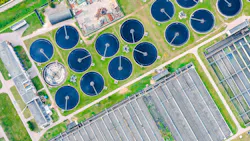

To ensure sustainable drinking water supplies, many of these regions are turning to domestic wastewater as a source of drinking water. To ensure this wastewater is treated to an advanced level of purity for reintroduction into the drinking water supply, specialized wastewater treatment plants, called advanced wastewater treatment facilities (AWTF), are constructed. AWTFs are often required to include the UV advanced oxidation process (UV AOP) as a part of the advanced wastewater treatment process due to its ability to treat chemical micropollutants found in wastewater sources and provide additional treatment for pathogens.
Water is naturally reused through the global hydrologic cycle. Potable reuse uses treatment systems to accelerate this natural process. AWTFs can send their advanced treated wastewater to an environmental buffer, such as a surface water basin or groundwater aquifer, before it goes to a drinking water treatment facility. This is indirect potable reuse (surface water augmentation and groundwater augmentation). Water from AWTFs that bypasses the environmental buffer and is sent directly to a drinking water treatment facility is direct potable reuse (raw water augmentation).
AWTFs typically use advanced membrane technology like microfiltration and reverse osmosis (RO) to remove small solids, some micropollutants, and some pathogens. However, even the most advanced membrane technologies, including RO, do not remove all micropollutants of concern. Advanced oxidation technology is considered a necessary treatment step following advanced membrane filtration to remove micropollutants that are not easily filtered from water.
California, an established leader in implementing potable reuse and constructing AWTFs, requires targeted UV AOP treatment for the 1,4-dioxane micropollutant. Further, N-nitrosodimethylamine (NDMA), a recognized byproduct of wastewater treatment, is also a commonly targeted micropollutant treated with UV AOP systems at AWTFs.
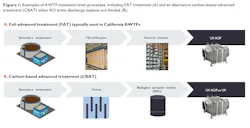
UV advanced oxidation process
UV AOP treats micropollutants by breaking chemical bonds rather than transferring them to another medium (e.g., air in air stripping or solids in carbon filtration) that moves the micropollutant to a different phase in the environment where further (off-site) treatment is often required.
When UV light is introduced into the water, it can be absorbed directly by targeted micropollutants. UV can also interact with specific oxidants, such as hydrogen peroxide or free chlorine, to generate powerful radicals that rapidly interact with and break down micropollutants, including 1,4-dioxane, rendering them harmless.
DUAL-TREATMENT APPLICATIONS WITH UV AOP
In many advanced treatment scenarios, utilities and water providers must address multiple treatment objectives.
A common requirement, for instance, is the treatment of pathogens, including bacteria and viruses. UV technology is a well-established and validated method for inactivating pathogens, including bacteria, protozoa, and viruses.
The amount of ultraviolet light required to treat micropollutants is most often significantly higher than the light needed to treat pathogens. This means that properly designed UV AOP installations targeting micropollutants can provide enough ultraviolet light power to achieve most pathogen treatment simultaneously.
The requirements for pathogen treatment can vary significantly from one application of UV AOP to another. AWTF and potable reuse UV AOP applications often have stringent pathogen treatment requirements, and ultraviolet light can achieve as high as a 6-log treatment credit for viruses, Cryptosporidium, and Giardia in these applications.
Using UV AOP to achieve micropollutant and pathogen treatment objectives in a single step streamlines treatment processes and reduces the need for additional equipment.
CHOOSING AN OXIDANT FOR UV AOP
Free chlorine molecules have a higher molar absorption coefficient (at most UV wavelengths) than hydrogen peroxide, meaning more free radicals can be produced using free chlorine than with equivalent amounts (moles) of hydrogen peroxide. Furthermore, different species of radicals can be generated, adding another oxidation mechanism during the UV AOP process.
For free chlorine to be effective, the pH of the water must be within a range that is primarily achieved after the water has passed through RO membranes. RO permeate is very clean with low levels of carbonate species, which reduces the risk of scavenging. Therefore, free chlorine’s advantages as an oxidant for UV AOP are best realized in potable reuse applications.
BENEFITS OF UV AOP
- Meet treatment objectives while minimizing operations
- Eliminate residuals that require additional treatment or disposal
- Reduce footprint and installation costs
- Cost-effectively treat micropollutants and microbial contamination