Mansfield expands water treatment capacity while keeping plant online
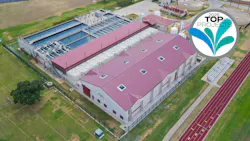
When a water treatment plant needs to expand, adding treatment capacity is only part of the challenge. At the City of Mansfield's Bud Ervin Water Treatment Plant, the project team also had to figure out how to make major infrastructure improvements without taking the plant out of service.
That challenge is at the center of the $50 million Bud Ervin Water Treatment Plant Phase V Expansion, one of WaterWorld's 2026 Top Projects.
The project is expanding the plant's advanced microfiltration/ultrafiltration (MF/UF) membrane treatment system, adding capacity for up to five additional membrane racks and designing the facility for an ultimate treatment capacity of 75 million gallons per day. The plant's existing facility has a capacity of 41.67 million gallons per day.
The expansion also addresses infrastructure throughout the plant, including the on-site sodium hypochlorite generation system, bulk chemical storage, high-service pumping, backup power and control systems.
Expanding without shutting down
The project's greatest challenge was maintaining continuous plant operations while construction took place.
The project team developed a detailed 16-step sequence of construction governing facility shutdowns and system transitions. The sequencing allowed critical infrastructure improvements to proceed while maintaining treatment capability and protecting the plant's ability to provide safe drinking water.
One of the most significant tie-ins involved a new 48-inch membrane filtrate inlet to Clearwell No. 1. The work was restricted to a 45-day construction window during the low-demand winter months, reducing operational risk and potential impacts to customers.
The team also performed hot taps into active 30- and 54-inch raw water pipelines, allowing new recycle piping connections without taking the plant out of operation.
At no point during construction was the plant without chlorination capabilities.
Mapping what was already there
Working inside an operating facility brought another complication: some of the existing infrastructure was aging and only partially documented.
To better understand existing conditions, the engineering team used terrestrial LiDAR scanning and low-altitude UAV photogrammetry to create highly accurate AutoCAD Plant 3D models.
Those digital models helped the team identify potential conflicts before construction and integrate new piping and equipment into the existing facility.
The project also incorporates computational fluid dynamics modeling and water chemistry modeling to optimize contact time calculations, as well as 3D laser scanning and virtual facility walkthroughs.
Building resilience into the expansion
The project goes beyond simply increasing treatment capacity.
New 500-horsepower vertical turbine pumps are being installed at both the Upper and Lower Pressure Plane High Service Pump Stations. The project also includes automatic transfer switches and redundant backup generators, including additional backup power for critical treatment processes such as on-site sodium hypochlorite generation.
Comprehensive PLC and SCADA integration is intended to improve control and visibility across the expanded facility.
High-efficiency plate settlers with hoseless sludge collector systems and advanced pressurized, outside-in hollow fiber membrane technology are also part of the project.
The project is being delivered through a Construction Manager At-Risk approach involving the City of Mansfield, Archer Western Construction and Plummer Associates. Equipment packages were evaluated using a point-based process that considered factors including capital cost, lifecycle cost, footprint, warranty and manufacturer references. Coordination continued throughout construction. The team held regular Value Engineering and scheduling meetings, and used the construction management platform Procore to give the City, CMAR, engineer and equipment vendors real-time access to RFIs, submittals, field reports and schedule updates.
A project built around continuity
For Mansfield, the expansion is ultimately about preparing the water system for continued growth while maintaining the reliability customers already depend on.
The project team had to solve the familiar problem of expanding critical infrastructure without getting in the way of the infrastructure's most important job: continuing to operate.
That combination of capacity expansion, complex construction sequencing, digital design tools and resiliency improvements earned the Bud Ervin Water Treatment Plant Phase V Expansion recognition as one of WaterWorld's 2026 Top Projects.
2026 Top Porjects
About the Author
 Mandy Crispin
Head of Content
Mandy Crispin is the editor-in-chief of WaterWorld magazine and co-host of water industry podcast Talking Under Water. She can be reached at [email protected].