How Carmichael Water District improved water quality, reduced flushing and gained system insight with one simple tool
Key Highlights
- Carmichael Water District operates a complex system blending surface water and groundwater to serve over 40,000 residents with a lean team of just six operational staff.
- The district faced persistent low chlorine residuals, especially in Zone Three, due to flow imbalances caused by a reassembled pressure-reducing valve.
- Installation of Cla-Val XP2F-CV35 pressure and flow monitors provided real-time data, revealing the root cause and enabling targeted valve repairs.
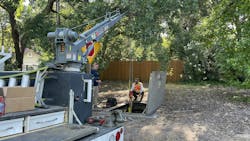
Serving more than 40,000 residents in Sacramento County, Carmichael Water District (CWD) operates a complex but lean system that blends surface water from the American River with groundwater to meet seasonal demands. The district has a 22-million-gallon-per-day microfiltration plant, two water storage tanks, and a network of wells that supplement the supply during peak summer use. Despite the size and sophistication of the system, there are six operational staff, including Production Superintendent David Biagi, who oversees the plant and all source water operations. “We are small,” Biagi explained. “We don’t have a maintenance team, we don’t have lab techs or instrument techs. We try and take care of everything ourselves, and what we can’t, we contract out.” Biagi also mentions that it takes the support of the entire 27 staff members to make the district run smoothly.
Addressing low chlorine residuals
Biagi has been with the utility for 16 years and has been Superintendent for the last three. Not too long ago, operators noticed they had an issue with low chlorine residuals. "We were seeing the residuals going from, say, 0.6 down to 0.2 in the west side of Zone Three. We were taking samples throughout the service area to try and determine where the issue was originating from" Biagi recalls. For a water utility, maintaining adequate chlorine residual throughout the distribution system is critical for water quality and regulatory compliance. But identifying why residuals were dropping proved challenging and time consuming.
CWD's distribution system is divided into three pressure zones to accommodate the area's terrain. Zone Two sits at a moderate elevation, while Zone Three serves customers at lower elevations. The El Camino Pressure Reducing Station (PRS) is situated on the west side of Zone Three that primarily serves commercial areas and high-density housing. This PRS includes one 3-inch and one 6-inch PRV. On the east side of Zone Three, the neighborhood is an established residential area with many large properties. This PRS contains one 4-inch and one 10-inch PRV. These Cla-Val pressure-reducing valves manage the transition between the elevation, stepping pressure down from 85 pounds to a more reasonable 65 pounds for downstream customers. The pressure-reducing valves sit in underground vaults, making it difficult to assess their operation. "You can go and check on the valves, and see the stem's up, or the stem's down, if it's open, closed, and so on," Biagi explains. "But it was hard to get a gauge on how the valves were reacting to demand and how much water was moving through each side."
The immediate response to low chlorine residuals is extensive flushing to try to improve circulation and boost the levels. During one season, crews were flushing tens of thousands of gallons weekly, sometimes 10,000 gallons at a time, and this continued for two to three months. It was costly, and it became evident that they were treating a symptom rather than addressing the root cause.
Discovering the root cause

As part of strengthening their valve maintenance, CWD sent operators to a hands-on valve training course at Cla-Val, which led to a deeper discussion about the district’s challenges. It was recommended that they retrofit the valves with the Cla-Val XP2F-CV35, a pressure- and flow-monitoring system designed to mount directly onto the existing control valves. This system is self powered, which was important as there was no power in the valve chambers. The data is sent via Cla-Val’s no-cost Link2Valves asset management program.
CWD installed four units in May 2024, one for each PRV in the two PRSs serving Zone Three. Almost immediately, the data exposed the root cause of their chlorine residual issue.
The 10” PRV at the California PRS had been previously serviced by an outside vendor and was reassembled incorrectly. As a result, it was continuously pushing water through the system, regardless of demand. This created an artificial imbalance: all the flow came from one pressure station, forcing the other PRV to stay closed. Instead of balanced movement of fresh water from both sides, water was only circulating from one pressure station during low-demand periods, creating the dead spots that led to declining chlorine residuals.
Once the issue was identified, Cla-Val and CWD partnered to completely rebuild all four valves. With the valves repaired and the XP2F units in place, the chronic flushing stopped. The water quality issue was resolved, and CWD had the visibility they needed.
Insight into flow, pressure and system behavior
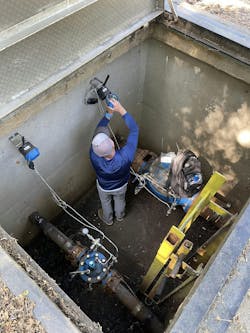
Installing the new monitoring system transformed how CWD understood and operated its pressure zones. “With the monitors in place, it just opened everything up,” Biagi said. “Now we can see exactly how much flow is going through each valve and equalize it as needed to keep the water age as fresh as possible.”
Instead of relying on visual checks of stem position, operators gained continuous access to upstream and downstream pressure, valve position, and flow rate, and total flow through each valve.
The combination of regular time flow data and pressure analytics allowed the team to confirm the valves were operating correctly after rebuilding them, and to continuously monitor the system as operating conditions change, particularly during seasonal transitions from surface-water-only operation to blended groundwater use.
Beyond water quality, the monitors serve as a valuable tool for leak detection and demand planning. For instance, the El Camino side of Zone Three has more businesses, and the California side is all residential, resulting in different usage patterns. This is helpful for Biagi’s team to plan for demand. Although CWD hasn’t identified nighttime anomalies that would suggest hidden leaks, the visibility into daily usage patterns, especially heavy morning irrigation demand, has given engineers a better understanding of system behavior and plan future capital projects. “It has helped the engineering department predict mainline problems, and enhances risk-based asset management, supports predictive maintenance on PRVs themselves, and reduces leaks and non-revenue water,” Biagi said.
In a district with limited staff but growing regulatory and operational pressures, tools that provide actionable, high-resolution system data are essential. For the Carmichael Water District, this technology solution didn’t just solve a chlorine residual problem; it has given the district a deeper, more accurate understanding of how water moves through its system, empowering operators and engineers to make informed, efficient, and sustainable decisions.
About the Author
 Collin Bryant
Collin Bryant
Collin Bryant is area sales manager, Northern California and Western Nevada, at Cla-Val.