Collaborative delivery drives fast-track water treatment expansion for Panasonic Energy in Kansas
Key Highlights
- The project expanded De Soto's water treatment capacity to 8 MGD, supporting Panasonic's EV battery manufacturing operations.
- Using the CMAR delivery method allowed early involvement, risk management, and phased construction to meet aggressive timelines without public funds.
- Offsite prefabrication and early procurement minimized delays, ensuring critical process components were ready on schedule.
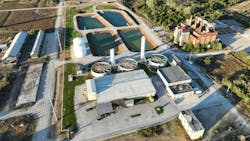
When Panasonic Energy selected the City of De Soto in 2022 for its new $4 billion electric vehicle (EV) battery plant — the largest private business investment in Kansas history (Kansas Dept. Of Commerce) — it created an urgent need to upgrade the city’s 80-year-old water treatment plant. The new 32-gigawatt-hour (GWh) plant, expected to employ up to 4,000 people, required a reliable and expanded water supply while the city continued serving residents and local businesses.
To meet the demanding industrial timeline, the city turned to collaborative delivery, using the construction manager-at-risk (CMAR) delivery method to expedite a major water treatment expansion. As the CMAR, Garney worked closely with the city, Panasonic, and lead engineer HDR to deliver the $43 million project, expanding the plant’s capacity to 8 million gallons per day (MGD) in just 14 months. The expansion was fully funded by Panasonic and completed without the use of public dollars.
If utilities can’t provide enough capacity and consistent quality, it can create challenges for both the project and local service, which is why cities must invest in water and wastewater infrastructure in lockstep with new EV battery plants.
Water plays a critical yet often overlooked role in EV battery manufacturing, supporting essential processes like mixing battery materials, rinsing, and cooling across large production facilities. Because demand can rival or exceed that of other large industrial operations, reliable, high-quality water service is essential for these projects. If utilities can’t provide enough capacity and consistent quality, it can create challenges for both the project and local service, which is why cities must invest in water and wastewater infrastructure in lockstep with new EV battery plants.
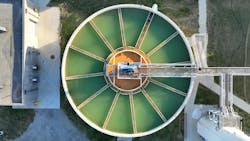
As construction on the EV battery plant took shape just down the road from the water facility, it reinforced how essential the expansion was to supporting Panasonic’s development.
During early site evaluations, our team saw an opportunity to strengthen the original plan. A comparative cost analysis showed that a new filter building would cost nearly as much as an extensive rehabilitation. Moving forward with new construction became a key design decision and allowed the project to limit disruptions to daily plant operations — exactly the type of early insight that collaborative delivery is designed to surface.
As the CMAR, Garney provided the flexibility to validate that strategy and manage associated risks. Early involvement allowed Garney to refine the scope, review constructability, and plan sequencing around ongoing plant operations. Working together, the project team developed guaranteed maximum price (GMP) packages with greater cost certainty, advanced design and construction through phased bid packages, and aligned procurement with the project’s aggressive timeline.
To keep the project on schedule, the team used strategies more commonly associated with rapid-delivery industrial work and adapted them to a municipal setting. Early bid packages allowed sitework, structural construction, and critical process areas to move forward while later design elements were being finalized. Long-lead equipment was procured in advance to mitigate supply chain risks. Where feasible, process units and building components were prefabricated offsite, improving quality control and reducing installation time once they reached the plant.
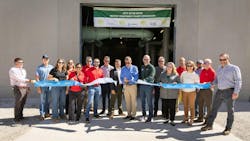
The expansion touched nearly every aspect of the treatment process and supporting infrastructure. The project added a new gravity filter building, increasing filtration capacity, and replacing older equipment that had reached the end of its useful life. New chemical feed and administrative buildings modernized operations and improved workflow for plant staff. An additional softening basin and lime silo system supported the capacity increase and redundancy, while two new 0.5 MG clearwells provided necessary storage and operational redundancy.
On the distribution side, new transfer and high-service pump stations were built to improve reliability and deliver higher flows to the community and Panasonic. Residuals management was strengthened through expanded lagoons, allowing the city to handle increased solids volumes more efficiently as production scaled up. Comprehensive electrical and supervisory control and data acquisition (SCADA) upgrades give operators better tools to manage the system in real time.
Panasonic’s investment helped launch this project, but the benefits go far beyond a single facility. The city now has a modern water system that can support future growth and potentially attract other manufacturing opportunities as well.
For other communities facing similar industrial growth, this project offers a model for how municipalities, private industry, and collaborative delivery teams can work together to accelerate critical water infrastructure.
About the Author
Bill Morehead
Bill Morehead is project manager at Garney.