Water reimagined: How LEED v5 elevates water performance, carbon accountability and commissioning
Key Highlights
- LEED v5 emphasizes a holistic, performance-driven water management approach that integrates water use, quality, and carbon considerations across the building lifecycle.
- The update expands the role of metering, leak detection, and water quality assessment to improve accountability, operational efficiency, and occupant health.
- Whole-project water use strategies are now central, recognizing diverse building types, especially industrial facilities, for their significant water and energy savings potential.

Water has long been a quiet partner in sustainable design and operation, viewed more as a secondary sustainability metric. In U.S. Green Building Council’s® (USGBC®) Leadership in Energy and Environmental Design™ (LEED®) v5, we furthered our efforts in highlighting water as a central driver of resilience, carbon reduction, and long‑term operational performance. This update reaffirms the growing climate pressures, infrastructure constraints, and the recognition that water carries both energy and carbon implications.
Over the past five years, I have had the privilege of serving on the USGBC Water Efficiency Technical Advisory Group, including three years as chair. That experience shaped my perspective on how LEED® must evolve from a prescriptive, efficiency-focused model to a comprehensive, whole-building analysis model for water stewardship. LEED® v5 represents the most major advancement in that journey.
Quick update on LEED® v5
The registration deadline for most LEED® v4 and v4.1 is fast approaching on June 30, 2026. Projects registering by this date will have until June 30, 2032 to submit their initial applications to the Green Business Certification Inc.TM (GBCI®) for certification. This article focuses on the updates in LEED® v5.
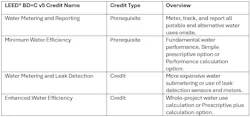
The LEED® for Building Design & Construction (LEED® BD+C) v5 Water Efficiency credit category includes:
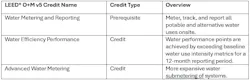
The LEED® for Building Operations and Maintenance (LEED® O+M) v5 Water Efficiency credit category includes:
The LEED® Project Priorities related to water include:
- Multi-Attribute Mechanical, Electrical, and Plumbing Products – recommend exploring this for environmental product declarations, as plumbing fixtures and parts are becoming more readily available.
- Water Quality Assessment – full section on water quality included below.
- Water System Commissioning – expanded commissioning scope beyond service water heating equipment.
From efficiency to stewardship
Regardless of credit pathway selected, it’s best practice to prioritize water efficiency as the first step to reduce consumption and demand, before seeking alternative water options. This is much like improving energy performance with highly efficient HVAC and lighting systems, prior to installing photovoltaic (PV) solar power system. The more efficient your building is, the less alternative water or power solutions are needed.
The industry has been transitioning from solely focusing on fixture‑based compliance of low-flow/flush fixtures toward a holistic water management approach. LEED® v4 and v4.1 laid the groundwork by introducing metering, reuse pathways and a broader understanding of water as a resource that must be monitored, managed and optimized like energy. LEED® v5 builds on this foundation by reframing water as a strategic asset linked directly to decarbonization, quality of life, and ecological conservation and restoration.
Several forces pushed LEED® v5 to strengthen its water performance requirements. Climate risk and water scarcity continue to intensify, placing new demands on buildings and utilities. At the same time, the energy‑water nexus has become impossible to ignore. Every gallon of water used in a building incurs an energy cost for pumping, heating, cooling, and treatment, and therefore a carbon cost.
Additionally, LEED® v5 further integrates water with other credits, including commissioning, which now covers metering being installed correctly, calibrated, and integrated with building automation systems.
LEED® v5 acknowledges these connections explicitly. It lays the groundwork for future water‑carbon modeling tools that will help design teams quantify emissions reductions associated with water savings and provide guidance for continued tracking throughout operations.
The technical leap: Whole‑project water use in LEED® BD+C
One of the most significant advancements in LEED® v5 is the elevation of the Whole-Project Water Use strategy from pilot credit (WEpc115) to a core component of the Water Efficiency category. In evaluating how previous versions of LEED® were applied across diverse markets, the LEED® Water Efficiency Technical Advisory Group (WE TAG) recognized that traditional prescriptive pathways did not consistently reflect the realities of all building types, particularly industrial and manufacturing facilities. These projects often faced difficulty achieving strong scores under earlier frameworks, despite demonstrating significant operational innovation and measurable performance gains.
Manufacturing facilities, in particular, represent substantial opportunities for both water and energy reduction, often exceeding the savings potential of conventional commercial office buildings. Many of these organizations have implemented advanced process-water optimization strategies, achieving reductions that save millions of gallons of potable water annually while also contributing to regional watershed restoration efforts. LEED® v5 responds to this opportunity by creating a structure that recognizes whole-project performance, rewarding measurable outcomes for high-consumption users while still maintaining a clear, prescriptive foundation for projects with lower process water demands.
Throughout development, the Water Efficiency Technical Advisory Group (WE TAG) collaborated closely with industry experts and USGBC® staff to ensure that LEED® v5 requirements are technically rigorous while remaining practical across global markets. The result is a more performance-driven framework that expands access, improves accountability, and better aligns water efficiency strategies with real-world operational outcomes.
Value of metering and leak detection
LEED® v5’s emphasis on measurement reflects a simple truth: “You can’t manage what you don’t measure.” LEED® BD+C and LEED® O+M v5 Water Efficiency credit categories each start with Water Metering and Reporting as a prerequisite to certification. With this requirement for metering and reporting, LEED® v5 strengthens the connection between design and proper long-term operations.
Water metering and leak detection are foundational strategies in comprehensive building water management, directly supporting potable water conservation, operational efficiency, and long-term asset protection. The intent of this LEED® credit is to promote accountability and performance transparency by tracking water consumption at the subsystem level while reducing the risk of material damage and water waste from undetected leaks. By providing real-time visibility into water use, project teams and facility managers can identify abnormal consumption patterns, diagnose inefficiencies, and uncover opportunities for additional water savings beyond baseline compliance.
Where water meets carbon
Water and carbon are interconnected through the energy required to pump, heat, and treat water. Every gallon conserved represents avoided energy use, ergo, reducing greenhouse gas emissions. LEED® v5 reinforces this relationship by encouraging project teams to first establish a water baseline and proposed design model. Essentially, the water model can be used to better quantify the carbon implications of water use and conservation strategies, strengthening the link between water efficiency and broader decarbonization goals.
On-site water reuse and net-zero water approaches are gaining prominence, particularly in drought-prone regions where the energy intensity of water treatment and distribution is significant. By highlighting these strategies within the rating system, LEED® v5 positions water stewardship as a critical component of long-term climate action and infrastructure resilience.
Looking ahead, the industry is moving toward greater integration across resource categories, with water, energy, and carbon performance increasingly monitored and reported through consolidated, real-time data and analytics platforms. This reflects a broader shift toward holistic resource management, where operational intelligence supports both environmental performance and strategic decision-making.
Healthy buildings and water quality
Water quality is an emerging priority in LEED v5, reflected in the pilot credit focused on assessing and managing incoming potable water to protect occupant health. This credit recognizes that building performance extends beyond energy and carbon to include environmental health factors that directly affect occupants. For one additional LEED point, projects are required to assess incoming water to identify potential health risks and inform water management and system design decisions. At minimum, teams must review the local municipal water quality report where available. For U.S. projects, teams must also evaluate regional lead risk using the Homewater101 U.S. Water Quality Map to better understand potential distribution system and source-water vulnerabilities. This early assessment supports proactive design strategies, particularly in areas with aging infrastructure or documented contamination concerns.
The credit further requires comprehensive water quality testing of incoming potable water. For renovation projects where existing plumbing remains, testing must occur at defined points of use to evaluate potential contamination from legacy piping or fixtures. Project teams must identify contaminants to test based on regional risks and project conditions, which may include lead, copper, Legionella, PFAS, disinfectant byproducts, or other location-specific pollutants. Documentation includes a detailed incoming water testing report and narrative describing sample locations (e.g., municipal supply line, point-of-entry, point-of-use), number of samples, and range of results. Projects must also clearly identify where potable water is available within the building and communicate water quality findings, any treatment measures (such as filtration or corrosion control), and the planned ongoing testing schedule to occupants. Communication strategies may include signage, digital dashboards, tenant manuals, or building management portals. Where risks are identified, teams are encouraged to establish measurable water quality improvement goals and engage water quality experts to develop corrective actions. This pilot credit reinforces transparency, public health protection, and long-term water stewardship as integral components of high-performance buildings. While not a core water credit yet, I’m eager to see the interest and feedback from project teams and owners that choose to document water quality within their buildings.
Commissioning’s expanding role
Commissioning professionals play a critical role in LEED® v5’s credit framework. Their responsibilities now extend beyond verifying equipment performance to validating the integrity of energy and water data itself. This includes confirming meter installation, calibration, BAS connectivity and data reporting pathways.
There is a growing demand for cross‑trained commissioning providers who understand both energy and water analytics. As buildings become more interconnected, commissioning must evolve to support integrated resource management beyond energy alone.
Diving into action
Water strategy discussions should ideally begin during goal setting and sustainability or design charrettes. At this stage, teams should:
- Establish project-level water performance goals (efficiency, health, resilience, reuse).
- Review municipal water quality reports and regional risks (e.g., lead risk via Homewater101 in the U.S.).
- Assess site water availability, infrastructure limitations, and drought vulnerability.
- Determine whether water reuse (rainwater, greywater, condensate) is feasible.
- Align Owner Project Requirements (OPR) with LEED® v5 water credits.
Decisions about plumbing system layout, irrigation strategies, potential water reuse systems, and even central plant designs are best evaluated early and are quite costly to change later. Early consideration also allows for the integration of submetering and leak detection infrastructure to be included from the start.
Water-efficient equipment installed during construction establishes the building’s baseline water performance, comparable to a vehicle’s EPA-rated miles per gallon. This baseline defines the expected level of efficiency under normal operating conditions. The objective during operations is to manage the facility with that benchmark in mind, using ongoing metering and performance reporting to track actual consumption, identify variances, and drive continuous improvement. Beyond LEED® BD+C certification, buildings may benchmark water performance using the, U.S. Environmental Protection Agency’s (EPA) ENERGY STAR® Portfolio Manager®.
Preparing for LEED® and beyond
At EEI, we are advising owners to proactively implement comprehensive water management strategies that reflect the growing complexity of building operations and reporting expectations. In today’s competitive and rapidly evolving marketplace, utility management extends well beyond cost control; it now requires transparent reporting, performance benchmarking, regulatory alignment, and integration with broader ESG objectives. Installing submetering infrastructure, tracking whole-building water consumption, and linking water data to centralized energy and sustainability dashboards are becoming fundamental elements of modern asset management.
As buildings grow increasingly dependent on real-time resource intelligence, we are seeing the emergence of new roles and responsibilities focused specifically on water performance and infrastructure oversight. Owners and operators are being asked to support analytics-driven operations and maintenance teams capable of interpreting data, identifying anomalies, and responding proactively to performance trends. Early and consistent data collection not only improves operational efficiency today but also positions assets for long-term resilience. With tightening regulations and expanding sustainability disclosure requirements, buildings equipped with robust measurement, verification, and reporting capabilities will be better prepared to demonstrate compliance, adapt to evolving standards, and maintain market competitiveness.
LEED® v5 marks a turning point in how the industry approaches water. No longer a quiet partner in sustainable design, water is now a measurable, verifiable and carbon‑linked performance metric. This evolution demands earlier collaboration among owners, engineers, designers and commissioning teams to deliver resilient, data‑driven outcomes from day one.
About the Author
 Rock Ridolfi
Rock Ridolfi
Rock Ridolfi, EEI leader and former chair of USGBC’s Water Efficiency Technical Advisory Group