How proactive utility-data center collaborations benefit communities
Key Highlights
- Data center growth driven by AI and digital commerce is reshaping water and energy consumption patterns across North America.
- Early utility-developer collaboration and infrastructure agreements are crucial for managing risks, costs, and community impacts effectively.
- Innovative cooling technologies like air-cooled and closed-loop systems reduce water use but may increase power demand, influencing overall resource planning.

Fueled by soaring demand for cloud computing, AI, and digital commerce, the growth of data center development is reshaping water and energy consumption across North America. This growth brings together fast-moving private developers, longer-range utilities, and communities concerned about infrastructure strains — and each may operate on different timelines.
Those misaligned planning horizons can create challenges for proactive collaboration between water utilities and data center developers. This gap may impact how effectively infrastructure needs and community priorities are addressed, though both sectors are interested in working together.
As the AI revolution accelerates, rapid data center expansion is heightening public concern about pressure on vulnerable water infrastructure. While public debate often centers on water-intensive cooling, the industry is shifting toward low- or no-water options like advanced air-cooled and closed-loop liquid systems.
These alternatives reduce direct water use but increase power needs, potentially raising indirect water consumption depending on energy source. As a result, the biggest impact of AI’s water footprint is not the data center itself, but upstream through power generation and embedded in chip manufacturing.
Data center siting hinges on many factors, including availability and cost of land, power, fiber, and water. Power availability and delivery remain key, stretching established hubs and driving growth in more remote areas with abundant power. These dynamics influence how utilities are engaged.
While water may not be the primary driver for siting decisions, water utilities can benefit from early coordination with power utilities and data center developers. Cross-sector collaboration, forward-looking procedures, and adaptive planning are strategies water utilities are implementing.
The challenge is to balance protecting community priorities and ensuring financial resilience of utilities in a way that is transparent, proactive, and responsive to real-world timelines.
Planning and risk mismatch
The data center industry moves quickly, often delivering new facilities in one to three years, while utilities plan and invest over longer horizons — 10 to 20 years. As a result, many utilities lack visibility into how data center growth affects infrastructure considerations, including:
- Water supply demand (annual average and seasonal demands)
- Wastewater discharge quality and permit compliance
- Conveyance and treatment capacity
Although this uncertainty complicates long-range planning, site-specific analysis can provide the insights needed for timely, well-informed decisions. Given the rapid pace of data center development, utilities must continue to evolve, building flexibility and resilience.
Without early engagement between utilities and data center developers, long-term risks can increase, especially for infrastructure timing, cost recovery, and system reliability.
Data center scale and complexity: Infrastructure implications
These risks are heightened by the scale and diversity of data center developments, where facility type, load including megawatts (MW) to gigawatts (GW), and cooling system technology can alter water and power requirements. The table below outlines typical MW ranges by data center category. While hyperscalers (or large facilities) grab headlines, smaller co-location and edge facilities can pose planning challenges for water and power utilities at the regional level.
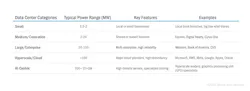
In the U.S., major markets include Northern Virginia, Chicago, Atlanta, and Phoenix. Northern Virginia remains the world’s largest market while facing ongoing power supply constraints and rising land cost, with power availability limiting growth.
Construction discharge is another infrastructure implication. Since water is used through the life cycle of the data center, from construction and commissioning to operations, discharges during construction could last up to two years and disrupt the municipal wastewater treatment plant if unprepared. Then, once operational, data centers also use water for domestic needs, cooling, and fire suppression.
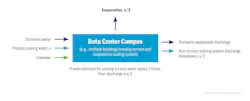
If using water for cooling, water demand, efficiency, and wastewater discharge are influenced by data center type, cooling technologies, climate, and water source quality. Because water impacts and challenges vary by region and specific data center operational setpoints, it is important that utilities partner with the specific facility operation to understand its needs.
Shaping outcomes
Proactive planning begins with early engagement that provides utilities with critical information from data centers and enables more sophisticated approaches to active management of risk, peak demand, and discharge compliance.
- Managing risk. While planned data center buildout is large and well-funded, deployment is tempered by operational, regulatory, and community challenges, creating a gap between development ambition and on-the-ground execution. To protect against the risk of a developer moving on to another site, some utilities are requiring non-refundable fees and readiness milestones.
Proactive procedures may also include establishing a clear basis for future cost and commitment discussions. Utilities can further reduce exposure with decommissioning plans to address the risk of stranded assets if the data center is abandoned.
- Managing peak demands. Effective water supply planning requires a clear understanding of seasonal variability and peak water demands. Data centers that rely on water for cooling may not use water year-round, but demand can spike during summer. Monthly use in summer can reach up to three times the average annual demand, while peak daily demand may be 10 times higher or more.
Peak demand often coincides with system vulnerabilities, such as low river-flow conditions, making water security a critical consideration. Managing peak demands may therefore require targeted investments to ensure reliable access when needed.
Initial water demands can be underestimated or overestimated. Data center operators may request conservative water allocations that are never fully realized, while actual needs may shift over time. Flexibility to renegotiate rates, combined with real-time tracking of water and energy use, can improve transparency, forecasting, and regulatory compliance.
The value of water security is high for data centers and across the broader AI value chain, where an outage can result in significant financial losses. To manage peak demand, utilities may require data centers to build onsite storage tanks, introduce industrial rate structures to recover peak-related costs, and resize water meters to more accurately capture usage and revenue.
- Managing discharges. Data centers typically connect to potable water supplies and discharge wastewater to local sewer systems. While approval procedures for routine operational discharges are well established, “temporary” discharges during construction and commissioning have posed challenges. Due to phased construction schedules, these “temporary” discharges may not be a one-time event.
To manage these risks, utilities should request detailed information on planned activities, schedules, and discharge quality, including chemical analyses and/or interim onsite holding prior to discharge approval.
Early discussions can also open the door to alternative water supplies. Using reclaimed water from a municipal source can be an effective way to reduce demand on potable supplies. Proximity to existing or planned recycled water infrastructure can be considered during site selection.
Early engagement enables planning, but formal agreements are what translate that planning into accountability.
Infrastructure agreements as cross-sector partnerships
Infrastructure agreements are often used to clarify how private development intersects with public water infrastructure systems and broader community considerations. They provide a structured way to document assumptions, timing, and responsibilities as projects move forward under compressed development schedules.
Such agreements can define practical elements of infrastructure coordination, including connection and use fees, cost‑sharing approaches, asset ownership and lifecycle responsibilities, as well as operational and maintenance roles. Establishing these details early helps reduce uncertainty as infrastructure planning and capital investments proceed.
When applied consistently, infrastructure agreements support clearer understanding of system impacts and investment needs, enable defined financial participation aligned with utility requirements, and provide a framework for long‑term stewardship of public assets.
This clarity is critical for utilities aiming to manage growth while maintaining system reliability and regulatory compliance.
Balanced partnership
As data center development accelerates, large, fast‑moving projects can trigger major system upgrades, require capital investments on shortened timelines, and introduce long‑term operational considerations that extend beyond a single project.
To address these challenges, utilities and developers often rely on structured coordination to clarify responsibilities, manage system impacts, align with community priorities, and meet regulatory mandates. Early definition of governance, financial participation, and operational roles supports more reliable system planning as development progresses.
This coordinated approach helps build public trust while enabling utilities to support economic development responsibly.
From reactive to resilient
As data center growth continues to outpace long‑term infrastructure planning, utilities must also adapt their approaches to address new scales of development, accelerated timelines, and system interdependencies. Large projects require earlier coordination to understand how growth will affect water, wastewater, energy, and related systems over time.
By aligning planning timelines, clarifying responsibilities, and managing long‑term risk through structured coordination and clear infrastructure agreements, utilities can maintain water system reliability while supporting economic growth.
Decisions made during the earliest stages of data center development often shape infrastructure performance, investment outcomes, and system resilience for decades to come.
About the Author
 Carla De Las Casas
Carla De Las Casas
Dr. Carla De Las Casas is Brown and Caldwell’s Water Stewardship Leader based in California. She supports clients in development of water stewardship strategies and programs with a focus on driving positive regional impacts.
Rebecca Maco
Rebecca Maco is Brown and Caldwell’s Technology Market Sector Leader based in Seattle. She supports client and project teams in the development of sustainable water and wastewater solutions for industrial facilities.