Ending the "emergency premium" on water infrastructure
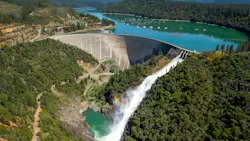
For decades, the water industry has been caught in an impossible balancing act. Facing tight budgets, staffing shortages, and a mountain of conflicting priorities, utilities sometimes postpone a shift toward predictive maintenance. They haven’t deliberately ignored their assets; they’ve just been forced into a constant state of triage. Waiting for a main to burst, a pump to give out, or a storm to overwhelm the system, and then scrambling to fix the damage.
That reactive cycle of patching pipes and handling daily emergencies was born out of necessity, but today it is completely unsustainable. Between extreme weather and assets stretched decades past their design life, merely putting out fires is no longer enough. To keep the water flowing, modern utilities need a new kind of prioritization – one that spots problems long before the pipes actually break.
Of course, the specific headache depends on your geography. On the U.S. east coast, agencies are often buried under century-old infrastructure that needs constant rehabilitation just to maintain baseline service. Out West, the story is usually about extreme drought and the high-stakes game of navigating water scarcity across many stakeholders.
But regardless of the location, the underlying need is exactly the same. Teams everywhere have to make smarter, more strategic use of limited resources. We need a clearer view of network health and the intelligence to act before a small problem becomes a catastrophic failure. By embracing tools like AI and digital twins, the industry can build a more secure water future nationwide.
The coast-to-coast contrast
To see why we need a unified digital approach, you have to look at how geography changes the strategy.
On the Eastern seaboard, the primary adversary is time. Major metropolitan areas are running water and sewer systems where some legacy components have been in the ground for over 100 years. For the organizations managing these historic networks, the daily hurdle is tracking capacity and prioritizing repairs on buried, decaying assets before they give way. The focus is almost entirely on physical integrity and keeping sewers from overflowing.
The Western states face a different kind of pressure. In places like California, water authorities have to capture and store every possible drop during wet years to survive the inevitable droughts. The priority here shifts to reservoir operations and safety and making sure water isn’t lost to a leak in the distribution network.
Even with these distinct mandates, both coasts share a fundamental problem: you cannot efficiently fix what you cannot see or understand. Whether it is an old pipe or a critical reservoir, you need better data.
What is a digital twin, really?
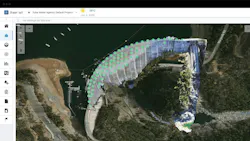
We hear the term "digital twin" thrown around constantly, but there is often confusion about what it actually means. The real question is: how is it any different from the GIS or asset maps we have used for decades?
Think of a GIS map as a static record. It is great at telling you where an asset is — the coordinates of a valve or the path of a main. But a digital twin is a dynamic, living representation of that system.
A traditional map shows you where a pipe is located, but a digital twin tells you how that pipe is performing right now. By integrating hydraulic modeling, SCADA data, and real-time sensors, digital twins allow engineers to run "what-if" scenarios. You can simulate a severe storm, a sudden pressure drop, or a population surge and see exactly how the network reacts before anything happens in the real world. That is the jump from just keeping records to actively anticipating risk.
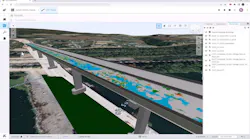 The new cloud product iTwin experience will help users visualize and navigate digital twins.
The "drone angle" in action
If digital twins provide the environment, artificial intelligence provides the analytical horsepower to make sense of the data. To be clear, AI is not a magic wand that magically repairs physical infrastructure. Instead, it is a tool for processing massive amounts of information to find patterns that humans might miss.
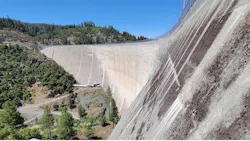
A great example of this is the New Bullards Bar Dam in California. Inspecting a 645-foot-tall structure is traditionally slow, expensive, and dangerous. It often involves personnel rappelling down the concrete face to look for cracks.
Today, using drones changes the equation. An unmanned aircraft can capture thousands of high-resolution images of the surface in a fraction of the time. AI can then scan that massive visual dataset to find anomalies, such as a minor spall or a crack, long before they become a threat. It transforms monitoring from a dangerous, manual task into a frequent, automated workflow that feeds directly into the digital twin.
The bottom line for utilities and consumers
Why does this technology actually matter to utility leaders and the communities they serve? Because shifting from reactive fixes to proactive planning changes the financial outlook of the entire organization.
When a utility is constantly reacting to emergencies, it pays a premium. Fixing a catastrophic main break at 2:00 AM requires overtime labor rates and expedited material costs, not to mention the damage to roads and local businesses. By using predictive analysis with digital twin data to spot failures early, organizations can optimize their spending. They can repair that same pipe on a planned Tuesday morning rather than a frantic Saturday night. Even better, replacing the pipe before it fails prevents those unexpected disruptions in service, which also helps improve the reputation of the utility itself.
That strategic shift has a direct impact on the everyday consumer. By cutting down the frequency and cost of surprise repairs, water authorities can stabilize their budgets and, by extension, help stabilize rates for the public.
Securing the future
Building resilient water systems is a shared priority across the country. Whether an agency is dealing with decaying pipes or drought-stricken reservoirs, we can’t solve modern challenges with legacy workflows.
By embracing these digital tools, the sector can finally move away from the expensive, reactive cycles of the past. They give us the intelligence to make confident, data-driven decisions today, ensuring a reliable and affordable water supply for the next generation.
About the Author
 Gregg Herrin
Gregg Herrin
Gregg Herrin is vice president, water, at Bentley Systems