Small water systems: How to unlock funds to address emerging contaminants
Key Highlights
- The EC-SDC program provides up to $1 billion annually to help small communities address emerging water contaminants like PFAS without cost-sharing requirements.
- Many eligible communities are unaware of the grant, and complex application processes hinder access to these funds.
- State agencies are responsible for administering grants, developing workplans, and ensuring compliance, but often face capacity challenges.

Millions of federal dollars – already allocated to U.S. states and territories to benefit water systems in their small, disadvantaged or Tribal communities – sit undistributed, even though the funds require no match or cost share and feature 100 percent principal forgiveness.
The funds’ source is the Environmental Protection Agency’s (EPA) Emerging Contaminants in Small or Disadvantaged Communities (EC-SDC) Grant Program launched in 2022 following passage of the Infrastructure Investment and Jobs Act enacted in November 2021.
So, what’s the problem? Communities are unaware of the grant. Designed specifically to help communities that lack financial capacity, the process to execute on the program has proven to be difficult both for the state departments responsible for communicating about it and, for eligible water systems wanting to apply for and access the funds.
Here’s the good news – help is available.
About EC-SDC
EC-SDC is designed to help small communities (generally, fewer than 10,000 people), disadvantaged communities and Tribal water systems deal with PFAS and other emerging contaminants in drinking water.
The grant program's annual appropriation is about $1 billion for each fiscal year from FY2022-2026. The annual amount awarded to each state can vary and is based on an allocation formula that includes factors such as population, number of water systems, and data related to emerging contaminants.
Eligible projects can include:
- Water testing and sampling
- Engineering studies and planning
- Preliminary design work
- Treatment system installation or upgrades
- Source water protection
- Technical assistance and operator support
- Household well testing in some cases
The program’s intention is to help small communities comply with newer drinking water standards without passing the cost of doing so to ratepayers.
How the program works
States and territories participating in the grant program had to submit a Letter of Intent which confirmed their participation and named the state agency that would administer the grants. Those agencies vary by state. Small communities or water systems can learn what department to contact by going to EPA’s Contacts for Emerging Contaminants in Small or Disadvantaged Communities Grant page.
The administering departments are then tasked with a scope of work often beyond their capacity in expertise or manpower:
- Develop project lists and workplans for EPA approval.
- Set rules for how disadvantaged communities are defined under their Drinking Water State Revolving Fund program.
- Identify eligible projects and communities.
- Award grants or subawards to local water systems and communities.
- Make sure projects meet federal requirements like procurement and reporting rules.
- Oversee compliance with Build America, Buy America (BABA) requirements.
- Track spending, progress and performance reporting.
- Coordinate with EPA regional offices during implementation.
- Help communities understand eligibility and funding requirements.
- In some cases, help communities pursue waivers or technical assistance.
- Submit final applications through Grants.gov and manage ongoing grant administration.
Small communities and water systems are similarly challenged in capacity to comply with what they must do to get funding, which can include:
- Contact the state drinking water program or revolving fund office.
- Show the community qualifies as “small” or “disadvantaged.”
- Identify an emerging contaminant problem, often PFAS.
- Conduct or document water testing results.
- Describe the public health or compliance issue.
- Develop a proposed project or scope of work.
- Prepare planning documents, engineering reports or cost estimates.
- Apply through the state’s funding process.
- Meet state procurement and reporting requirements if awarded funds. Complete the approved project and provide documentation back to the state.
Help is available – state resources
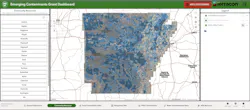
Grant fund applicants can see if their state has gone beyond simply posting EPA guidance and have created dedicated, state-run webpages, portals or application hubs specifically designed to help small communities and water systems navigate EC-SDC or PFAS-related funding.
Some states developed full portals or dashboards specifically to simplify applications for small public water systems. They include:
- Arkansas: Its centralized funding dashboard housed under the Arkansas Department of Agriculture Natural Resources Division, tracks water infrastructure funding opportunities, including PFAS and emerging contaminant assistance tied to EC-SDC implementation.
- California: Its PFAS-related funding portal is tied to its State Water Board assistance programs. While broader than EC-SDC alone, it serves the same practical purpose by consolidating PFAS funding opportunities, eligibility, deadlines and technical assistance information.
- Wisconsin: Its portal features downloadable application forms, environmental review forms, FAQs, eligibility rules, rolling deadlines, funding caps and instructions tailored to small systems.
Several states such as Colorado, Kansas, Maine, South Dakota and Virginia, have built detailed EC-SDC guidance pages. Other states administer EC-SDC mainly through existing Drinking Water State Revolving Fund offices or general environmental agency webpages rather than standalone portals or pages.
EC-SDC dashboards like that developed by Arkansas take a load of work off the backs of both state administrators and small community and water system staff by pulling nearly all the information needed for a successful grant application into one place. Highlights include:
- Public water system size, type, and source
- Population and social vulnerability
- Emerging contaminant sampling data / heat map
- Water/wastewater affordability index
- Other Arkansas Department of Agriculture (ADA) resources
- A link to apply for funding
That leaves to the applicant the work to inventory EC risk per water source and EC contributing industries, determine population/disadvantaged status, identify an eligible activity, and apply for funding.
Help is available – TEC Water TA
Established by EPA, the Tackling Emerging Contaminants (TEC) Water Technical Assistance is an initiative that delivers direct, community-centered technical assistance to small or disadvantaged communities’ water systems.
TEC regional administrators use data from state health department’s raw water sampling for contaminants to determine which systems may be eligible for TEC assistance. Under the Unregulated Contaminant Monitoring Rule (UCMR), the tests seek to identify contaminants that are not yet fully regulated or are newly regulated, including many PFAS compounds.
EPA and TEC teams review that data to identify water systems with detectable PFAS or other emerging contaminants that are approaching or exceeding proposed or final EPA health limits and that also do not have the staff, expertise or money to respond on their own. TEC administrators then use that data to prioritize outreach and technical assistance.
UCMR data itself does not automatically qualify a water system for EC-SDC funding or TEC assistance. It is more like an early warning and screening tool. EPA and states still typically evaluate system size, disadvantaged community status, contaminant levels, public health risk, compliance concerns, readiness for a project and funding need.
TEC’s no-cost service can be a difference maker for small communities and water systems, helping them with:
- Sampling and analysis activities such as initial monitoring
- Technical plans including analysis, preliminary engineering reports, and source water protection plans
- Implementation support/funding deliverables, for example, identifying funding options and preparation of funding application materials
- Operational training support like sampling training, operator training for new treatment systems, operation manuals, and standard operating procedures
- Public outreach including providing customer education and risk communications about PFAS or emerging contaminants, and identifying and hosting public events and other opportunities to educate community members
The clock is ticking
While states have been allowed to bank their annual ED-SDC funding allocation, EPA is losing patience. It may begin asking states to return funds if they cannot demonstrate meaningful progress toward getting the money distributed and spent.
Some states are able to point to their portals and dedicated guidance, show that public meetings are occurring and that applications are coming in. Others not as far along can engage with water systems’ consulting engineers, develop those specialized resources simplifying the process and/or coordinate with EPA resources like TEC Water TA to start making progress.
For small communities already struggling with aging infrastructure, limited staff and tight budgets, the EC-SDC grant program may represent a once-in-a-generation opportunity to address emerging contaminants before they become a larger public health and financial crisis.
However, the program’s grants only help if communities know the funding exists and can successfully navigate the process to access it. States that simplify applications, improve outreach and coordinate technical assistance are likely to move funds faster and help more communities protect their drinking water systems before EPA’s patience – and funding – run out.
About the Author
 Brad Wingfield
Brad Wingfield
Brad Wingfield, P.E., manages the Engineering Department in Terracon’s Little Rock, Arkansas, office and brings 20 years of civil engineering experience focused on water resources, wastewater management, and regulatory compliance. He serves as Terracon’s Emerging Contaminant Grant Program Manager, supporting PFAS treatment through granular activated carbon pilot systems and helping communities secure funding and evaluate emerging contaminants.