The water loss paradox: Everyone's problem, no one's priority
Key Highlights
- Water loss is a decision-making problem, not just an infrastructure or technology issue, requiring strategic prioritization of limited resources.
- Utilities possess extensive operational data across multiple systems, but fragmentation hampers effective decision-making; integration is key.
- AI and analytics serve to reduce uncertainty, support prioritization, and enable smarter operational decisions rather than merely detecting leaks.
Every water utility knows it loses water. Most have quantified non-revenue water (NRW), conducted leak detection studies, evaluated pressure management strategies, or discussed the need for greater investment in water loss reduction. Yet despite decades of industry attention, water loss remains one of the most persistent and underfunded operational challenges facing utilities today.
At first glance, this seems contradictory. Water loss represents one of the largest opportunities to improve operational efficiency, reduce costs, defer capital expenditures, and strengthen long-term system resilience. Consultants continue to study it, technology providers continue to introduce new tools, and utilities recognize the financial and operational impacts of leakage, meter inaccuracies, and distribution system inefficiencies. Still, meaningful and sustained investment in water loss management remains inconsistent.
The reason is that water loss is not simply an infrastructure problem or a technology problem. It is fundamentally a decision-making problem, where the most important decision utilities face is how to prioritize limited people, time, and resources. That challenge is shaped by the way utilities are structured to operate.
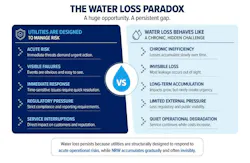
Water utilities are exceptionally effective at managing risk. Every day they balance regulatory compliance, public health, water quality, aging infrastructure, service reliability, cybersecurity, workforce challenges, and financial constraints. These demands require difficult decisions about where limited people, time, and funding will have the greatest impact. Water loss must compete against all of them.
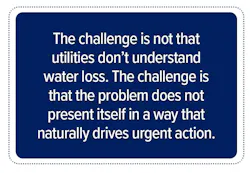
Understanding this distinction changes the conversation. The challenge is not convincing utilities that water loss matters. The challenge is helping them confidently determine where to act, when to act, and how to prioritize limited resources for the greatest operational benefit. That shift in perspective has important implications for how we think about engineering, data integration, analytics, and ultimately the role of AI in water loss management. Water loss remains a significant challenge, with many utilities reporting NRW levels between 10% and 30% or higher1, but solving it requires more than finding leaks. It requires helping utilities make better operational decisions.
The fundamental paradox of water loss
Water loss exists within a difficult operational paradox: it represents one of the largest efficiency opportunities available to utilities, yet utilities are not primarily organized around efficiency optimization. Instead, they are organized around managing risk.
This distinction is critical because utility operations are naturally shaped by immediate, visible, and high-consequence events. Regulatory compliance violations, water quality incidents, service interruptions, major main breaks, cybersecurity threats, and public health concerns all demand urgent action because failure carries direct operational, financial, regulatory, and reputational consequences. Utilities must therefore focus much of their attention and resources on maintaining reliable services and responding first to the most visible and consequential risks.
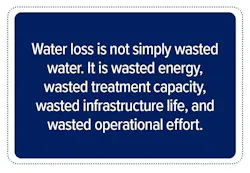
Water loss behaves very differently. According to the EPA WaterSense Program2, most leakage develops gradually beneath the surface, often without disrupting service or attracting public attention. The American Water Works Association has repeatedly emphasized that water loss represents far more than lost water volume alone3. While the cumulative impacts can be significant, including wasted treated water, increased energy and chemical consumption, accelerated infrastructure deterioration, and the potential to defer costly capital projects, those benefits are realized over time and often across multiple parts of the organization rather than through a single measurable outcome. In contrast, the investments required to reduce water loss, such as leak detection, district metering, pressure management, monitoring technologies, and engineering support, are immediate and highly visible.
This creates the central paradox of water loss management. Utilities understand the long-term value of reducing NRW, but the problem rarely competes successfully against more immediate operational demands. Water loss is not ignored because utilities fail to recognize its importance; it is deferred because the organizational systems used to prioritize work naturally favor acute, high-consequence events over chronic efficiency challenges.
Multiple global studies, including work by the World Bank, have shown that NRW reduction requires sustained operational commitment rather than one-time technology deployments4. Recognizing this distinction changes the conversation. The question is no longer, "Why aren't utilities investing in water loss?" A better question is, "How can utilities address water loss within the operational realities they face every day?" That question shifts the focus from simply identifying leaks to improving the quality of operational decision-making.
Why water loss is hard to solve
Even when utilities commit to reducing NRW, determining where to act is rarely straightforward. Water loss is often treated as a single problem, but it is actually a collection of interconnected challenges with different causes, consequences, and solutions. Physical leaks, meter inaccuracies, unauthorized consumption, operational inefficiencies, and data quality issues all contribute to NRW, and each demands a different engineering response.
A utility may know it is losing water yet still struggle to determine whether the greatest benefit will come from replacing aging infrastructure, improving meter accuracy, optimizing pressure management, investigating abnormal flow patterns, or addressing data quality issues. Limited budgets, constrained staffing, and competing operational priorities make those decisions even more difficult.
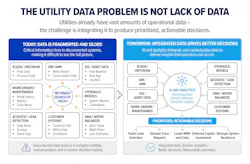
Compounding the challenge is the fact that the information needed to make these decisions is rarely found in one place. Operational data exists across SCADA, AMI, GIS, hydraulic models, asset management systems, work orders, and leak detection programs. Each provides part of the picture, but none provides the whole story.
As a result, water loss has become less of a detection problem than a decision-making problem. The question is no longer whether water is being lost, it is where utilities can take action to achieve the greatest operational impact.
Utilities already possess enormous amounts of data
If water loss is fundamentally a decision-making problem, the next question is whether utilities have the information needed to make better decisions. In most cases, they do.
The industry's challenge has evolved. Historically, utilities struggled with visibility into water loss because the information needed to understand system performance simply wasn't available. Today, utilities generate and manage enormous amounts of information across nearly every aspect of their operations. SCADA systems continuously monitor flow and pressure. AMI and AMR systems capture customer consumption. GIS platforms document network infrastructure. Asset management systems track maintenance history and condition assessments. Hydraulic models simulate system performance, while work orders, district metered area balances, customer service records, and, in many cases, acoustic monitoring programs all contribute valuable operational insight.
The information already exists, but it is fragmented across separate systems, managed by different departments, varies in quality and consistency, and is rarely evaluated together. As a result, engineers and operators must piece together information from multiple sources before they can confidently determine where to investigate, what actions to take, or where limited resources will have the greatest operational impact.
This evolution is reflected in the EPA's Effective Utility Management framework, which identifies data integration, business intelligence, and operational decision support as foundational capabilities for modern utility management5. For years, the conversation has centered on finding more leaks, collecting more data, or deploying new technologies. Those efforts remain important, but they address only part of the problem. The greater challenge is integrating fragmented information into a trusted understanding of system performance.
Reframing water loss as a decision-making problem
Viewed through this lens, the role of digital tools, advanced analytics, and AI becomes much clearer. Their primary purpose is not simply to process more data or detect more leaks. Utilities rarely lack awareness that water loss exists. The challenge is determining where limited resources will have the greatest impact. The real value of these technologies is helping utilities reduce uncertainty, prioritize opportunities, and make faster, smarter, and more confident operational decisions.
This distinction is important because utilities are not asking abstract technology questions. They are asking operational questions:
- Which pipe segments are most likely leaking?
- Which areas of the system are deteriorating over time?
- Where should limited field crews be deployed first?
- Are losses driven primarily by leakage, metering issues, or operational anomalies?
- Which interventions create the greatest operational value within current budget constraints?
These are fundamentally decision-making problems. The organizations that will be most successful at reducing NRW will not necessarily be those that collect the most data. They will be those that are best able to transform operational information into timely, trusted, and actionable decisions.

From decision support to operational action
If the challenge is helping utilities determine where to act, then digital tools, advanced analytics, and AI should be evaluated based on how well they support that objective. Their value lies not in replacing engineers or simply detecting more leaks, but in helping utilities reduce uncertainty, prioritize opportunities, and translate information into action.
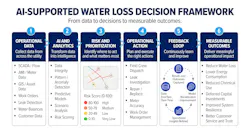
Rather than stopping at reports and dashboards, an AI-supported decision framework continuously evaluates information from across the utility to answer the questions that matter most to operations.
An effective AI-supported water loss program follows a continuous decision framework that connects operational data to field actions and, ultimately, to improved system performance.
Operational information answers “What is happening?”
Every utility already possesses valuable operational information, including SCADA, AMI/AMR, GIS, asset management, hydraulic models, work orders, leak detection results, and customer records. Individually these systems offer valuable insight. Together they provide the foundation for understanding water loss.
AI and analytics answer “Why is it happening?”
The next step is transforming data into intelligence. AI and advanced analytics help validate data quality, identify abnormal operating patterns, evaluate historical trends, develop predictive models, and quantify risk. Rather than replacing engineering expertise, these tools reduce uncertainty and help utilities understand where further investigation is warranted.
Risk and prioritization answer “What should we do next?”
Information alone does not improve performance, prioritization does. AI helps evaluate the likelihood, consequence, and operational significance of potential water loss issues so utilities can focus on what matters most. Instead of treating every leak or anomaly equally, utilities can prioritize investigations and investments based on operational risk, system impact, available resources, and expected return.
Operational action delivers results
Operational action is where value is created. Every step in the framework exists to improve the quality of this moment. Whether dispatching field crews, repairing infrastructure, improving meter accuracy, adjusting pressure management, or initiating additional inspections, the objective is to ensure utilities take the right actions at the right time.
Feedback loop answers “Did our actions work?”
Every operational decision creates new information. As investigations are completed and repairs are made, the results feed back into the system, improving data quality, refining predictive models, and strengthening future recommendations. Over time, this continuous learning process increases confidence in operational decision-making and improves the effectiveness of water loss programs.
Measurable outcomes inform continuous improvement
The ultimate measure of success is not the deployment of AI, it is measurable operational improvement. Better decisions lead to reduced water loss, lower energy and chemical consumption, deferred capital expenditures, improved system resilience, and increased customer confidence. These are the outcomes utilities care about, and they are the reason AI should be viewed as a decision support capability rather than simply another technology investment.
The framework also illustrates why technology alone cannot solve the water loss challenge. Engineering expertise, operational experience, field investigation, and organizational commitment remain essential. AI contributes by reducing uncertainty and improving prioritization, but lasting value is created only when better decisions are translated into effective operational action.
The future of water loss management
The future of water loss management will not be defined by which utilities deploy the most sensors, collect the most data, or implement the most advanced AI. It will be defined by which utilities consistently make better operational decisions.
That requires a shift in mindset. Water loss can no longer be viewed as an occasional engineering study or an isolated technology initiative. It must become a continuous operational capability that connects engineering expertise, integrated data, practical analytics, and day-to-day operations into a cycle of informed action and continuous improvement.
The opportunity is no longer to simply understand where water is being lost. It is to help utilities confidently determine where to act, when to act, and how to make the best use of limited people, time, and resources.
Ultimately, the future of water is not about collecting more information, it is about transforming information into action. The utilities that succeed will be those that consistently make better decisions, take the right actions, and continuously improve their performance.

References:
- American Society of Civil Engineers. Drinking Water Infrastructure — 2025 Report Card for America’s Infrastructure. https://infrastructurereportcard.org/cat-item/drinking-water-infrastructure/
- S. Environmental Protection Agency WaterSense. Fix a Leak Week. https://www.epa.gov/watersense/fix-leak-week
- American Water Works Association. Water Loss Control. https://www.awwa.org/resource/water-loss-control/
- Kingdom, B., Liemberger, R., and Marin, P. The Challenge of Reducing Non-Revenue Water (NRW) in Developing Countries: How the Private Sector Can Help — A Look at Performance-Based Service Contracting. World Bank, 2006. https://documents.worldbank.org/en/publication/documents-reports/documentdetail/385761468330326484
- S. Environmental Protection Agency. Effective Water Utility Management Practices. https://www.epa.gov/sustainable-water-infrastructure/effective-water-utility-management-practices
About the Author
Jennifer Steffens
Jennifer Steffens, PE, is digital water technical practice director for Carollo Engineers.