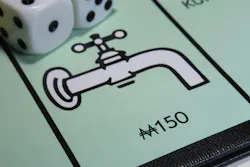
For Christmas last year I gave members of my leadership team a picture of the classic Water Works Monopoly card. On the back was the inscription, “If it earned a place on a board game a century ago, you know it matters.”
Unfortunately, the value of water is often realized in its absence. Whether it’s finding a drink on a hot summer day, dealing with widespread outages following a natural disaster or facing a building moratorium, we best understand how precious water is when it is not available. And yet, much like the hearer of the word in the book of James who does not act, we are like the man observing his natural face in a mirror who turns away and immediately forgets what kind of man he is.
When crisis strikes, the elected board over that water supply sees with urgency they need to eliminate the crisis, restore safe and reliable service and prevent the crisis from recurring. But once the crisis passes, how quickly they forget the lack of funding, efficiency and oversight that got them into the situation. One cannot fault elected officials who are responsible to the populace that elects them, but rate increases to address not only increasing costs but also expanding replacement needs must become part of the annual vernacular.
Four years ago, when I joined the City of Fort Myers, we had just been devastated by Hurricane Ian which exposed our underinvested water supply infrastructure. In the immediate aftermath of the storm, we had portions of the city without water for days and more devastatingly, hospitals had to be evacuated due to lack of fire protection. Beyond the direct impact of the storm, we were dealing with a water supply that due to the 2008 recession had not been properly expanded for growth. We consumed all the available capacity in the system and then some.
Over the first three years of my tenure, we committed more than $200M to improving our water supply. It took us 18 months from the hurricane to restore our water supply to where it needed to be. It will take us through the end of the decade to finish projects that secure our supply for the future. Each of the city council members who was there for the crisis remembers it vividly, but council members change and time softens the edge of all crises.
As utility leaders it is our job not to manufacture or wait for a crisis, but to remind our elected leaders of the criticality of constant reinvestment. For our part, we must also strive to increase water quality and system reliability while driving down the cost, building trust that we are not wasting rate payers’ money. More than a constant influx of capital into our utilities, we must embrace the triple goal of becoming faster, better, and cheaper. Some management gurus will say you can pick any two of the three at once but can’t have all three simultaneously. That, however, is more indicative of weak creativity than a universal axiom.
Many of us are complacent with where we are both as organizations and as individuals. We must make decisions that will make us uncomfortable. We must challenge our assumptions about how this industry works and find new, more efficient ways of doing business. Failing that, we will continue repeating the cycle in which crisis drives overspending, overspending prompts underspending, and underspending creates the next crisis. If our only ability to convince people of water’s value is its absence, we will always be on the precipice of another disaster.
About the Author
 Jason Sciandra
Jason Sciandra
Director of Public Utilities for the City of Fort Myers
Jason Sciandra serves as the Director of Public Utilities for the City of Fort Myers, Florida. He joined the city in 2022, bringing over two decades of experience following a successful career in the consulting industry. In his current role, Mr. Sciandra oversees water and wastewater operations, leads implementation of the City’s Capital Improvement Program, and drives the department’s adoption of innovative technologies and digital transformation.