Key Highlights
- Purple pipes are color-coded to distinguish reclaimed water from potable and wastewater lines, preventing cross-connections and ensuring public health safety.
- They support water conservation by enabling reuse in irrigation, industrial cooling, and other non-potable applications, especially in drought-prone regions like California and Florida.
- Advanced treatment processes such as filtration, disinfection, and reverse osmosis prepare reclaimed water for various uses, with safety measures including labeling and backflow prevention.
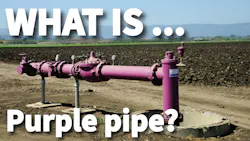
In water and wastewater systems, few visual cues are as instantly recognizable as purple pipe. Whether running alongside roadways, through industrial facilities, or across irrigation systems, these distinctly colored pipelines play a critical role in expanding water reuse and conserving potable supplies.
But what is purple pipe, and why has it become a cornerstone of modern water infrastructure?
What is purple pipe in water systems?
Purple pipe refers to pipelines specifically designated to carry reclaimed or recycled water—non-potable water that has been treated to a level safe for certain uses but not for drinking.
The color purple is not arbitrary. It is a standardized designation used across the United States and many other countries to clearly distinguish reclaimed water lines from potable water, wastewater, or other utility pipelines. This visual differentiation helps prevent accidental cross-connections and protects public health.
In the U.S., purple pipe systems are commonly guided by standards and best practices from organizations like the American Water Works Association (AWWA) and state regulatory agencies.
Why is purple pipe used? Key benefits for utilities
Purple pipe systems are a central component of water reuse programs, allowing utilities to stretch limited water supplies while reducing environmental impacts.
1. Conserving potable water supplies
One of the primary drivers behind purple pipe adoption is the need to preserve drinking water. By using reclaimed water for non-potable applications, utilities can reserve high-quality treated water for human consumption.
This is especially critical in drought-prone regions, but it is increasingly relevant nationwide as utilities face population growth, climate variability, and stricter regulations.
2. Supporting sustainable water reuse
Purple pipe enables a wide range of reuse applications, including:
- Landscape and agricultural irrigation
- Industrial cooling and process water
- Toilet flushing in commercial buildings
- Dust control and construction uses
- Power generation and data center cooling
According to the U.S. Environmental Protection Agency (EPA), water reuse can significantly reduce freshwater withdrawals and improve long-term water resilience.
3. Reducing wastewater discharges
By diverting treated effluent into reuse systems, purple pipe infrastructure reduces the volume of wastewater discharged into rivers, lakes, and oceans. This can help:
- Lower nutrient loading
- Improve receiving water quality
- Reduce regulatory compliance pressures
In some advanced systems, reuse also supports aquifer recharge and indirect potable reuse, further closing the water cycle.
4. Enhancing system resilience
Purple pipe networks create redundancy in water supply systems. In times of drought or emergency, reclaimed water systems can continue supplying non-potable demands, easing strain on drinking water infrastructure.
This diversification is increasingly viewed as a best practice in integrated water management.
How does purple pipe water get treated?
Water conveyed through purple pipes typically undergoes advanced wastewater treatment, though the exact level depends on its intended use.
Common treatment processes include:
- Secondary biological treatment
- Filtration (e.g., sand or membrane filtration)
- Disinfection (chlorine, UV, or ozone)
For higher-end applications, such as indirect potable reuse, additional processes like reverse osmosis and advanced oxidation may be used.

Where are purple pipe systems most common?
Purple pipe systems are most widely deployed in:
Western United States
States like California, Arizona, and Nevada have long relied on water reuse due to chronic water scarcity. Cities such as Irvine, Las Vegas, and Phoenix have extensive purple pipe networks.
Florida and the Southeast
Florida is a national leader in reuse, particularly for irrigation and groundwater recharge, driven by both water supply and environmental considerations.
Growing adoption in the Midwest and beyond
While historically less common in water-abundant regions, reuse—and by extension purple pipe—is gaining traction in the Midwest and Great Lakes regions. Drivers include:
- Nutrient management requirements
- Aging infrastructure
- Industrial water demand
- Climate variability
Purple pipe standards and safety considerations
Because reclaimed water is non-potable, strict safeguards are required to ensure it is not mistakenly used for drinking.
Key safety measures include:
- Color coding: Purple pipes, valves, and signage
- Labeling: Clear “non-potable water” markings
- Backflow prevention: To avoid cross-connections
- Operator training and certification
Failure to properly separate systems can pose public health risks, making design, maintenance, and oversight critical.
Challenges facing purple pipe expansion
Despite its benefits, purple pipe infrastructure comes with challenges:
High capital costs
Installing separate distribution systems can be expensive, particularly in built-out urban areas.
Dual plumbing requirements
Buildings must be designed or retrofitted with separate piping systems to use reclaimed water internally.
Public perception
Some communities remain hesitant about water reuse, even for non-potable applications, requiring robust outreach and education.
Regulatory complexity
Standards for reuse vary by state and application, creating a patchwork of requirements for utilities to navigate.
The future of purple pipe in water reuse
As utilities move toward circular water management, purple pipe systems are expected to expand—especially as part of integrated strategies that include:
- Direct and indirect potable reuse
- Decentralized water systems
- Industrial water recycling
- Smart water networks
Emerging pressures—from PFAS regulations to climate-driven water stress—are also accelerating interest in reuse solutions that maximize every drop.
In this context, purple pipe is more than just a color-coded pipeline—it is a visible symbol of a broader shift toward sustainable, resilient water infrastructure.
Why purple pipe matters for the water sector
For water professionals, understanding purple pipe is essential to navigating the future of water management. It represents:
- A practical tool for water conservation
- A pathway to regulatory compliance
- A foundation for advanced reuse systems
- A key asset in long-term infrastructure planning
As reuse moves from niche to mainstream, purple pipe will continue to play a central role in helping utilities balance supply, demand, and sustainability in an increasingly water-constrained world.
About the Author
 Alex Cossin
Alex Cossin
Associate Editor
Alex Cossin is the associate editor for Waterworld Magazine, Wastewater Digest and Stormwater Solutions, which compose the Endeavor Business Media Water Group. Cossin graduated from Kent State University in 2018 with a Bachelor of Science in Journalism. Cossin can be reached at [email protected].