Key Highlights
- Evaporation ponds use solar energy and natural processes to reduce wastewater volume by evaporating water, leaving behind salts and contaminants.
- They are commonly employed in industries like mining, oil and gas, desalination, and municipal wastewater treatment, especially in arid regions.
- Design features include shallow depths, impermeable liners, and large surface areas to maximize evaporation rates.
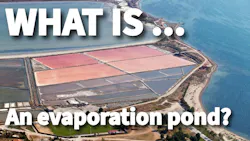
Evaporation ponds are one of the oldest — and still one of the most widely used — water management tools in the world. From wastewater treatment and mining operations to oil and gas production and desalination facilities, evaporation ponds play a critical role in managing concentrated liquids and reducing wastewater volumes.
As utilities and industrial facilities face growing pressure around water reuse, brine management and zero liquid discharge (ZLD) strategies, evaporation ponds continue to evolve alongside modern treatment technologies.
What is an evaporation pond?
An evaporation pond is a shallow, engineered basin designed to hold water or wastewater while allowing the liquid portion to naturally evaporate into the atmosphere. As the water evaporates, dissolved salts, minerals and contaminants remain behind in concentrated form.
Evaporation ponds are typically constructed with liners made from clay, geomembranes or other impermeable materials to prevent seepage into surrounding groundwater systems. Most are designed to maximize surface area exposure to sunlight, wind and heat – the primary drivers of evaporation.
The concept itself is simple: use solar energy and natural evaporation processes to reduce wastewater volume.
The practice has existed for thousands of years. According to the U.S. Geological Survey, humans have long used evaporation ponds to recover salt and minerals from seawater and brines.
What is the purpose of an evaporation pond?
The primary purpose of an evaporation pond is to manage wastewater or brine streams that are difficult, expensive or impractical to discharge or treat conventionally.
In the water and wastewater sector, evaporation ponds are often used to:
- Reduce wastewater volume
- Concentrate salts or dissolved solids
- Support zero liquid discharge systems
- Manage industrial brines
- Handle concentrate from reverse osmosis systems
- Store wastewater prior to treatment or disposal
- Recover valuable minerals or byproducts
Evaporation ponds are especially common in arid and semi-arid regions where high temperatures, low humidity and strong sunlight accelerate evaporation rates.
Facilities that commonly use evaporation ponds include:
- Municipal wastewater systems
- Mining operations
- Power plants
- Oil and gas facilities
- Food processing plants
- Desalination facilities
- Industrial manufacturing operations
In some wastewater lagoon systems, evaporation also plays a role in overall treatment performance. The U.S. Environmental Protection Agency (EPA) lagoon wastewater guidance notes that lagoon systems remain widely used in smaller and rural communities because they offer relatively low-cost wastewater management using natural biological processes.
How do evaporation ponds work?
Evaporation ponds rely on a straightforward physical process: liquid water transforms into water vapor and leaves the pond surface.
The rate of evaporation depends on several environmental and operational factors, including:
- Air temperature
- Solar radiation
- Humidity
- Wind speed
- Pond depth
- Surface area
- Water chemistry
In general, shallow ponds evaporate more efficiently because they expose more water surface area to the atmosphere.
Many facilities use multiple ponds in sequence. One pond may receive incoming wastewater, while others concentrate remaining solids or salts over time. Some operations also recover minerals or solids after evaporation is complete.
For example, mining operations often use brightly colored evaporation ponds to concentrate lithium, potash or other minerals from brines. Wastewater and desalination facilities may use ponds to manage reverse osmosis concentrate or brine streams that cannot be discharged directly.
What types of evaporation ponds are used in water infrastructure?
Evaporation ponds vary significantly depending on the application.
Industrial evaporation ponds
Industrial facilities frequently use evaporation ponds to manage high-salinity or high-total dissolved solids (TDS) wastewater streams. Industries including mining, refining and chemical manufacturing often generate brines that are difficult to discharge under regulatory permits.
Wastewater evaporation ponds
Some wastewater stabilization ponds incorporate evaporation as part of the overall treatment process. These systems are more common in smaller communities and rural regions where land availability is greater and mechanical treatment costs may be prohibitive.
Solar evaporation ponds
Solar evaporation ponds are specifically designed to maximize evaporation using sunlight and natural heat. These are common in mineral extraction and salt recovery applications.
Zero liquid discharge evaporation ponds
In ZLD systems, evaporation ponds may serve as the final stage for concentrating residual brines after mechanical treatment systems recover as much water as possible.
What are the environmental concerns surrounding evaporation ponds?
Although evaporation ponds can be cost-effective, they also present environmental and operational challenges.
One major concern is seepage into groundwater systems if liners fail or ponds are improperly constructed. Regulatory agencies often require monitoring wells and engineered liners to reduce contamination risks.
Wildlife impacts are another concern. Birds and other animals may mistake ponds for natural water bodies, particularly when ponds contain elevated salinity or contaminants.
Odor management can also become an issue in some wastewater applications. Texas regulations governing evaporative lagoons, for example, specifically require facilities to manage odor impacts and maintain adequate evaporation capacity.
In addition, evaporation ponds require large land footprints – particularly in regions with lower evaporation rates.
As water scarcity intensifies and concentrate management becomes more complex, some utilities and industrial operators are exploring alternatives such as mechanical evaporators, crystallizers and advanced brine concentration technologies.
Are evaporation ponds still widely used?
Yes – despite advances in treatment technology, evaporation ponds remain an important part of modern water and wastewater management.
In many regions, they continue to offer a relatively low-energy and cost-effective method for handling difficult wastewater streams. However, increasing regulatory scrutiny around groundwater protection, PFAS management and water reuse is reshaping how facilities design and operate evaporation ponds.
Emerging technologies are also changing the conversation. Researchers are now studying ways to improve solar evaporation efficiency and reduce pond footprints as part of broader zero liquid discharge strategies.
At the same time, climate pressures are increasing interest in water recovery and reuse – meaning utilities and industrial operators are evaluating whether evaporation remains the best long-term option for every application.
Why evaporation ponds matter to the water industry
Evaporation ponds sit at the intersection of wastewater treatment, brine management, water reuse and industrial sustainability.
As utilities face growing challenges around PFAS treatment residuals, desalination concentrate, produced water management and industrial wastewater disposal, evaporation ponds remain both a practical solution and a topic of increasing regulatory attention.
For water professionals, understanding how evaporation ponds work – and where they fit within broader treatment and reuse strategies – is becoming increasingly important as the industry navigates tightening environmental standards and growing water scarcity concerns.
About the Author
 Alex Cossin
Alex Cossin
Associate Editor
Alex Cossin is the associate editor for Waterworld Magazine, Wastewater Digest and Stormwater Solutions, which compose the Endeavor Business Media Water Group. Cossin graduated from Kent State University in 2018 with a Bachelor of Science in Journalism. Cossin can be reached at [email protected].