Anaheim’s groundbreaking PFAS treatment initiative: Restoring local water supply
Key Highlights
- Anaheim responded to new PFAS standards by developing the largest treatment plant program in the U.S., aiming to treat more contaminated water daily than any other utility.
- The utility adopted a phased approach, with early treatment plants coming online by mid-2023, utilizing ion exchange technology for its efficiency and versatility.
- Operator engagement and collaboration with design-build teams were prioritized to ensure staff readiness and smooth project execution amidst pandemic-related delays.
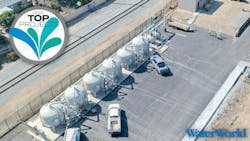
Location: Anaheim, California
Facility size: 27,200 GPM
Budget cost: $56,894,500
Manufacturers: AqueoUS Vets, Filtrek, Rockwell, DeZurick
When California’s State Water Board issued new PFAS response levels in early 2020, Anaheim Public Utilities (APU) faced an unprecedented challenge: nearly 70% of the city’s water supply was suddenly offline. The new guidance forced APU to shut down most of its 19 groundwater wells after detections of per- and polyfluoroalkyl substances (PFAS), pushing the city to rely heavily on imported water from the Metropolitan Water District—water that was twice as expensive and less reliable than local supplies.
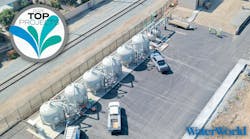
APU responded with an aggressive, multi-year campaign to restore its groundwater production, launching the largest PFAS treatment plant program in the nation, according to the utility. APU is constructing nine treatment facilities in three major phases, including four plants completed in Phase A with a combined capacity of 27,200 gpm (39.2 MGD). Once fully built, Anaheim’s program will treat more PFAS-contaminated water per day than any other utility in the United States, the utility stated.
A phased strategy for rapid restoration
To begin rebuilding its local supply, APU partnered with the Orange County Water District and developed a phased plan that allowed the first treatment plants to come online by mid-2023. Because PFAS treatment was entirely new to the utility, APU brought on an Owner’s Advisor to support planning and procurement of a Design-Build (DB) team—an approach the water division had not used before.
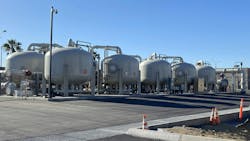
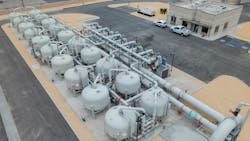
Throughout planning and design, APU studied the full range of available PFAS treatment technologies. The team ultimately selected ion exchange due to its high efficiency, small physical footprint, and absence of brine or backwash waste. APU also prioritized equipment versatility, choosing vessels capable of operating with multiple media types to accommodate future advancements.
Each facility incorporates a comprehensive treatment process—prefiltration, booster pumps, VFDs, ion exchange vessels, motor-controlled valves, and disinfection—along with well pumps and motors. For Anaheim, it was the largest capital project ever undertaken.
Operator engagement and DB collaboration
One of APU’s earliest challenges was operator readiness. Prior to this program, Anaheim’s wells required only disinfection, leaving operators with no experience running advanced treatment systems.
APU made operator engagement a central priority. Engineers involved operations staff throughout planning, design, and construction, ensuring operators could learn the technology early and voice concerns. The DB team was required to run each treatment plant for at least one month, addressing operational issues and training staff. Detailed process control narratives and standard operating procedures helped operators build confidence before full handoff.
The design-build delivery method also fostered weekly coordination among APU, its Owner’s Advisor, the DB team, the construction manager, and plant operators. This collaborative environment helped resolve issues early and avoided costly surprises later in the project.
Overcoming pandemic-era delays and permitting challenges
Much of the program’s design work occurred during the COVID-19 pandemic, which brought severe supply-chain delays—including year-long setbacks on electrical equipment. To mitigate rising costs associated with extended reliance on imported water, APU and its consultants developed a plan to start the first two plants using existing, older electrical components until replacements arrived.
Permitting delays posed another challenge. Because the DB contractor had limited experience with the City’s permit processes, APU facilitated closer collaboration with permitting departments to improve communication and accelerate review timelines.
Space limitations at many well sites created additional obstacles. Several locations lacked sufficient room for new treatment systems, prompting the DB team to employ 3-D modeling to minimize plant footprints. APU also acquired land and easements where needed. Two sites ultimately proved infeasible, requiring APU to abandon those wells and construct replacements elsewhere.
Community outreach and site integration
Because many treatment facilities sit within residential areas and parks, APU prioritized community outreach. Staff went door to door to hear concerns, hosted public meetings, and offered a 24-hour construction hotline. Despite the scale of the work, APU reported minimal issues thanks to proactive communication and coordination.
“Managing the construction and commissioning of nine PFAS treatment plants with a capacity of 72 MGD, and maintaining regulatory compliance and daily operations for 348,000 customers, in such a short period of time, was challenging and exhilarating at the same time,” said Divya Agrawalla, principal civil engineer, Anaheim Public Utilities
A model for PFAS treatment nationwide
Today, Anaheim’s PFAS treatment program is restoring the city’s local groundwater supply while setting a national benchmark for rapid, large-scale PFAS response. The first four treatment plants are online, and future phases are moving forward.
The program is already being viewed as a model—both for its technical success and for the collaboration that made it possible. Through careful planning, operator engagement, community outreach, and adaptive problem-solving, APU has built one of the nation’s most ambitious PFAS treatment systems and restored a critical, cost-effective water source for its residents.
2025 Top Projects



About the Author
 Alex Cossin
Alex Cossin
Associate Editor
Alex Cossin is the associate editor for Waterworld Magazine, Wastewater Digest and Stormwater Solutions, which compose the Endeavor Business Media Water Group. Cossin graduated from Kent State University in 2018 with a Bachelor of Science in Journalism. Cossin can be reached at [email protected].