Lake Powell hits record low as Colorado River crisis deepens
Editor's note: This story was updated on August 19, 2026, to clarify information that referenced a previous study.
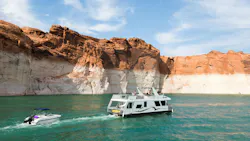
Lake Powell, the second-largest reservoir in the United States, has fallen to a record-low elevation, adding pressure to an already strained Colorado River system that supplies water and hydropower to communities across the Southwest.
The reservoir reached 3,519.91 feet above sea level on Saturday, according to U.S. Bureau of Reclamation data, slipping below its previous record low set in April 2023. The lake is now more than 20 feet lower than it was at the beginning of 2026.
The decline comes roughly a week after Lake Mead also reached a historic low, leaving the two major Colorado River reservoirs with their lowest combined storage in nearly seven decades. The Colorado River system supplies water to more than 40 million people across Arizona, California, Colorado, Nevada, New Mexico, Utah and Wyoming and supports agricultural production, ecosystems and hydropower generation.
Hydropower concerns grow
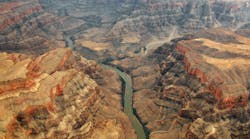
Lake Powell's declining elevation is particularly significant for the region's power supply. Glen Canyon Dam's hydroelectric turbines require the reservoir to remain above approximately 3,490 feet, known as the minimum power pool. Powell is now only about 30 feet above that threshold. If the reservoir falls below it, Glen Canyon Dam would no longer be able to generate hydropower through its turbines.
The Bureau of Reclamation has already taken steps intended to stabilize Lake Powell. Earlier this year, the agency said it planned to move as much as 2.48 million acre-feet of water into Powell by reducing releases from the reservoir and drawing on water from upstream Flaming Gorge Reservoir.
A "24-Month Study" published in April 2026 estimated that Lake Powell could decline below 3,490 feet in August without major intervention. Reclamation projected that the steps taken could raise Powell's elevation to an estimated 3,500 feet by April 2027.
The immediate challenge is being compounded by poor inflows. Reclamation reported that unregulated inflow into Lake Powell during June was only 12% of average, while the reservoir ended the month at about 24% of live capacity.
Pressure on Colorado River management
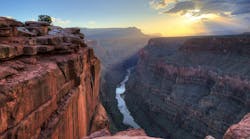
The reservoir declines come as federal officials and the seven Colorado River Basin states work toward a new framework for managing the river after 2026. Existing operating guidelines are scheduled to expire at the end of the year.
The Bureau of Reclamation has said a decision on post-2026 operations will be made before Oct. 1, 2026. Its draft environmental review evaluates multiple approaches for operating Lake Powell, Lake Mead and other Colorado River facilities, but the agency has not selected a preferred alternative.
The worsening reservoir conditions increase the stakes of those negotiations. Reclamation has been evaluating potential changes that could require significant reductions in water use, particularly in the Lower Basin states of Arizona, California and Nevada.
The current conditions are the product of more than a single dry season. The Colorado River Basin has experienced prolonged drought, low runoff and increasing temperatures while demand has continued to place pressure on available supplies. This year's especially poor snowpack further reduced the amount of water reaching the reservoirs. A regional climate assessment found that Upper Colorado River Basin snowpack peaked at a record-low percentage of median levels this year, with April 1 inflow forecasts for Lake Powell at just 22% of average.
For water utilities and communities dependent on the Colorado River, the latest reservoir records underscore the importance of conservation, demand management, water reuse and diversified supplies as long-term management decisions are made.
About the Author
 Alex Cossin
Alex Cossin
Associate Editor
Alex Cossin is the associate editor for Waterworld Magazine, Wastewater Digest and Stormwater Solutions, which compose the Endeavor Business Media Water Group. Cossin graduated from Kent State University in 2018 with a Bachelor of Science in Journalism. Cossin can be reached at [email protected].