Signal Butte Water Treatment Plant expansion strengthens Mesa’s long-term water resilience
Key Highlights
- The project doubles the plant’s capacity from 24 MGD to 48 MGD, supporting Mesa’s rapid growth and reducing groundwater reliance.
- Construction was carefully coordinated around plant shutdowns, with contingency plans allowing work during operational periods to minimize service disruptions.
- Advanced treatment upgrades include ozone generation, new filters, and on-site disinfection, enhancing water quality and operational flexibility.
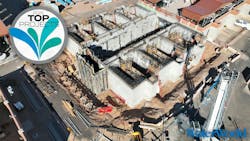
Location: Mesa, AZ
Facility size: 48 MGD
Budget cost: $168 million
Manufacturers: Veolia Water, WesTech, DeNora, Trillium
Mesa, Arizona’s $168 million expansion of the Signal Butte Water Treatment Plant stands out as a top water infrastructure project, reflecting both the scale of growth in the East Valley and the operational complexity required to meet it. Delivered as a construction manager at risk (CMAR) project, the multi-phase expansion will double the plant’s treatment capacity from 24 million gallons per day (MGD) to 48 MGD, ensuring reliable potable water service for one of the region’s fastest-growing residential, commercial, and technology corridors.
Originally constructed in 2018, the Signal Butte facility treats Colorado River water delivered via the Central Arizona Project. Rapid development in Mesa’s Eastmark community and surrounding tech-focused economic areas drove the need for expanded capacity, redundancy, and long-term sustainability. By doubling treatment capacity, the City of Mesa aims to reduce reliance on groundwater, strengthen system reliability, and provide operational flexibility during outages at neighboring facilities.
The expansion is structured in two phases and two guaranteed maximum prices (GMPs). Phase 1, completed at the end of 2025, focused on system resilience and set the foundation for future growth. This phase included construction of a new 8-million-gallon potable water reservoir and the addition of redundancies throughout the plant to maintain reliability during expansion activities. Phase 2, which began in summer 2024, delivers the core capacity increase and advanced treatment upgrades, including sand-ballasted flocculation, ozone generation, six new filters, expanded solids handling, additional chemical systems, and on-site sodium hypochlorite generation for disinfection. Once complete, Phase 2 will significantly enhance both treatment performance and operational flexibility.
A partnership built on communication and careful sequencing allowed construction and plant operations to coexist seamlessly,
- Senior Project Manager Oscar Munoz
Beyond its technical scope, the Signal Butte project is notable for how the project team has navigated construction within an active, essential facility. To complete major tie-ins and critical work, the team planned around two full-plant shutdown windows each year, typically four to eight weeks in the spring and fall. These shutdowns are not guaranteed, however, as they depend on factors such as rainfall, regional water demand, and scheduled maintenance. To manage this uncertainty, the project team worked closely with the City of Mesa to align procurement, staffing, and sequencing plans while also developing contingency strategies.
“A partnership built on communication and careful sequencing allowed construction and plant operations to coexist seamlessly, resulting in 150+ successful tie-ins with zero disruption — a true masterclass in coordination and teamwork,” said senior project manager Oscar Munoz.
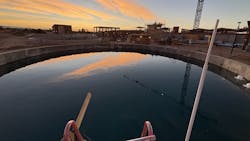
That flexibility proved critical when lower-than-average rainfall allowed the team to avoid a planned fall shutdown. Instead, select work—including valve replacements and installation of CO₂ isolation valves—was completed during plant operations using shorter, targeted shutdowns. More complex tie-ins, such as connecting new filters to the existing system, were deferred to a future spring shutdown. The team also demonstrated agility when the City requested that the new reservoir be returned to service earlier than planned. Through daily coordination with suppliers, the reservoir was completed and brought online two weeks ahead of schedule, supporting operational needs without compromising quality or safety.
Cost control and logistics were another defining feature of the project. Limited laydown space initially required hauling approximately 20,000 cubic yards of excavated material offsite, only to later import new backfill. By partnering with the City’s Parks, Recreation, and Community Facilities division, the team temporarily used adjacent park space for material storage, enabling reuse of the original backfill. This approach reduced costs, shortened schedules, and improved overall sustainability.
The project has also faced a highly competitive labor market, with major data center and semiconductor projects underway across Metro Phoenix. To mitigate risk, the contractor coordinated early with local unions, invested heavily in pre-job training, and leveraged self-perform teams across concrete, civil, and process mechanical scopes. This strategy ensured adequate skilled labor during critical shutdown windows and maintained schedule certainty.
As Mesa continues to grow, the Signal Butte Water Treatment Plant expansion exemplifies how large-scale municipal water projects can balance advanced treatment, operational continuity, cost control, and workforce challenges—delivering resilient infrastructure designed to serve communities for decades to come.
2025 Top Projects




About the Author
 Alex Cossin
Alex Cossin
Associate Editor
Alex Cossin is the associate editor for Waterworld Magazine, Wastewater Digest and Stormwater Solutions, which compose the Endeavor Business Media Water Group. Cossin graduated from Kent State University in 2018 with a Bachelor of Science in Journalism. Cossin can be reached at [email protected].