Phoenix team turns a 144-week lead time into a schedule gain
Key Highlights
- The plant, originally built in 1964, averages about 100 MGD and can treat up to 150 MGD.
- The project replaces 17 conveyors, improves access in the Dewatering Building and adds a 3,300-square-foot East Electrical Building.
- A letter of intent enabled early switchgear submittals despite a 144-week procurement lead time.

A 144-week equipment lead time is the kind of number that can dictate an entire construction schedule.
That was the situation facing the team rehabilitating the City of Phoenix's Deer Valley Water Treatment Plant. The electrical switchgear required for a new East Electrical Building had a procurement lead time of nearly two and a half years, putting project completion on track for the end of 2027.
Instead, the team found a way to bring that schedule forward by nearly 480 days.
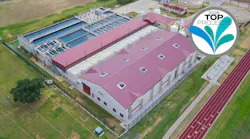
The Deer Valley Water Treatment Plant Rehabilitation is one of WaterWorld's 2026 Top Projects.
Modernizing a critical plant
Originally constructed in 1964, the Deer Valley plant provides drinking water to a large portion of Phoenix and operates at an average daily flow of approximately 100 million gallons per day, with capacity up to 150 MGD.
The $38.2 million rehabilitation project addresses aging infrastructure, particularly in the plant's Dewatering Building, while adding electrical redundancy to improve operational flexibility.
The work includes replacing 17 conveyors, modifying the Dewatering Building's second-floor structure to improve maintenance access and constructing a new 3,300-square-foot East Electrical Building. More than half a mile of duct bank was also installed.
But the work had to be carefully coordinated around the plant's role as a critical drinking water facility.
Solving the switchgear problem
The project team initially faced a 144-week procurement lead time for the switchgear required by the new electrical building.
Wilson Engineers and McCarthy Building Companies worked with the City of Phoenix and the electrical manufacturer to establish a letter of intent covering an initial 10% work package. That allowed submittals for the switchgear to be created and approved before the Guaranteed Maximum Price for the remainder of the project was finalized.
McCarthy then self-procured the switchgear and established twice-weekly meetings with the manufacturer to keep project requirements and fabrication moving.
The switchgear arrived in March 2025 rather than the originally targeted September 2026 delivery date, providing nearly 480 days of schedule savings.
Two shutdowns, carefully planned
The project also required two planned plant-wide shutdowns.
The first, in early 2025, lasted three months and focused on replacing the 17 conveyors in the four-story Dewatering Building and reconfiguring the cross conveyors.
The existing cross-conveyor configuration created maintenance problems because plant personnel did not have enough space to fully open the conveyor lids. The project team lowered the structural steel second-floor mezzanine by nearly two feet and relocated one cross conveyor to the second floor, creating more room for operations and maintenance.
The second shutdown, in early 2026, lasted two months and focused on electrical work.
Previously, the plant's A and B 5-kilovolt feeds were located within a common manhole. An electrical problem could therefore require the plant to be completely de-energized. The project separated the feeds and connected them to the new East Electrical Building, creating redundancy so the plant can continue operating at full capacity if one feed fails.
Planning before the plant went offline
With only five combined months of planned shutdown windows available for critical work, preparation was essential.
The team developed 30 Maintenance of Plant Operations sequences across the two phases. City representatives, plant operations staff, Wilson and McCarthy reviewed the plans together, developed contingency plans and coordinated trade partner activities.
Before the second shutdown, the team completed extensive prework, including installation of duct banks, conduits and feeders. That meant the shutdown could be focused on the work that actually required the plant to be offline.
The result was a project that relied as much on preparation as on construction.
For the City of Phoenix, the rehabilitation addresses aging equipment while strengthening the electrical resilience of an important drinking water facility. For the project team, it also demonstrates what can happen when procurement, preconstruction and shutdown planning are treated as part of the construction solution rather than as separate tasks.
That combination earned the Deer Valley Water Treatment Plant Rehabilitation recognition as one of WaterWorld's 2026 Top Projects.

About the Author
 Mandy Crispin
Head of Content
Mandy Crispin is the editor-in-chief of WaterWorld magazine and co-host of water industry podcast Talking Under Water. She can be reached at [email protected].
Related
 Pexels Pixabay 262353