Community partnerships drive MMSD's water workforce development pipeline
Key Highlights
- MMSD’s workforce development strategy focuses on community engagement, education, and training to prepare local residents for water industry careers.
- Programs like Waves of Change and RISE provide hands-on experiences, internships, and mentorships to foster interest and skill development among youth and college students.
- Community partnerships are central to MMSD’s approach, ensuring information and opportunities are accessible and relevant to diverse populations.
- The initiatives aim to create multiple entry points into water careers, from awareness and exploration to professional training and employment.
- Investing in local talent not only addresses workforce shortages but also promotes regional economic resilience and environmental sustainability.
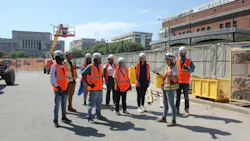
Anyone who works in water has heard of the “silver tsunami” — the coming wave of retirements in the water industry.
While that challenge is reason enough for utilities to invest in workforce development, the motivation at Milwaukee Metropolitan Sewerage District extends beyond filling vacancies.
“At MMSD, we view workforce development as an investment in both our community and our mission,” said Executive Director Kevin Shafer. “Protecting water quality and maintaining critical infrastructure requires a skilled workforce, but it also requires creating opportunities for local residents to participate in that work. When we invest in people, we're investing in the long-term resilience of our region.”
The efforts began with the building of MMSD’s Deep Tunnel system in the 1990s. The tunnels hold excess stormwater during periods of intense precipitation to prevent overflows of the combined sewer system found in parts of the Milwaukee area.
MMSD wanted to make sure residents benefited not just from fewer overflows, but also from the stable, family-supporting jobs created by the project.
“Since the construction of the Deep Tunnel and the associated infrastructure investments that followed, we wanted to maximize that impact for local workers and local businesses,” said Pete Coffaro, Director of Public Engagement. “Workforce development has always been part of MMSD’s broader commitment to ensuring public infrastructure investments create lasting economic opportunities in the communities we serve.”
As the utility delves deeper into workforce development, it has broadened its programming in partnership with local community groups. Based on community demand, it is sharing the career opportunities available in water with younger audiences and offering more in-depth experiences for those who want them.
Coffaro categorizes MMSD’s offerings into three buckets along a continuum: career awareness, career exploration and career training.
“The goal is to meet young people wherever they are in their career journey — from initial exposure to environmental careers, to hands-on exploration, to paid training and professional experience. Together, the programs create multiple entry points into the water workforce.”
Here is an example of MMSD’s programming in each of those buckets.
Awareness: Find your path towards a career in water
When MMSD wanted to create a series of videos advertising water careers to young people, it went straight to the source. It asked TRUE Skool, a Milwaukee center for creative arts and hip hop, to find teens to offer their feedback.
“We intentionally stepped back and let young people lead the conversation,” Coffaro said. Source TEN, a local videography company, created the original concepts for the video and then presented them to about a dozen teens, who were given a stipend (and pizza!) to share their thoughts.
“They had a really good video that they brought to us, but we added a little bit of creativity,” said Mahala Sy, one of the participants. The group offered suggestions such as livening up the music, breaking the video into several shorter videos and showing more young workers.
“We all felt really heard,” she said. “We felt like the videos they brought back were definitely revised, and they took our notes.”
One of the best parts, she said, was seeing real MMSD workers whom she had met before through the Environmental Youth Collaborative, another initiative MMSD supports.
It’s a no-brainer for TRUE Skool to work with MMSD on career pathways in water, said Fidel Verdin, Co-executive director.
“That water conversation translates on so many levels,” he said. “For us it’s an entry point to talk about global conversations as it relates to the environment, policy and individual responsibility.”
Sy, who is now 22, has taken what she learned at TRUE Skool to heart as she considers a career in sustainability or art. She currently works for TRUE Skool as a bookkeeper and owns a henna tattoo business.
“In my art I connect with environmentalism,” she said. “Although I’m leaning more toward entrepreneurialism, it ties into the water because I will forever represent my environment. That will forever stay as one of my top priorities.”
Exploration: Waves of change
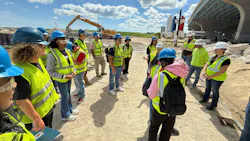
MMSD exposes many students to the water industry through tours, school visits and community events. But how do you retain interest long term in students who are too young for college or apprenticeships?
In 2025, MMSD launched Waves of Change, a paid, week-long course in environmental careers for people aged 14-24 in partnership with the Milwaukee Environmental Collaboration Office; Reflo, a green infrastructure nonprofit; and the Environmental Youth Collaboration, a coalition of organizations offering sustainability-related internships.
The program offers hands-on programming along three tracks: civil engineering and design, environmental health and water quality, and blue-green trades.
“It’s a really unique exposure to blue-green careers and the educational pathways to get to those careers,” said Justin Hegarty, Reflo Executive Director. “The amount of resources and access that we’re aligning for these young people is unprecedented.”
In its first year, more than 120 students applied for 45 spots. for this year’s program, happening Aug. 17-21.
The strong response confirmed what MMSD and its partners suspected: Young people are eager for hands-on opportunities to explore environmental careers.
Camilah De Leon participated last year after her engineering teacher and mentor shared the program with her. She already knew she wanted to study engineering, but she didn’t have much firsthand experience with it, she said.
“I hadn’t really done something professional with engineering or seen it in the real world, so that’s what really captivated me,” she said.
As part of the civil engineering track, she visited a green infrastructure schoolyard project, toured the University of Wisconsin-Milwaukee’s engineering school, observed construction of MMSD’s dredged materials management facility and saw several urban flooding infrastructure projects.
The program happened just a few days after Milwaukee experienced damaging flooding after record-breaking rainfall. De Leon didn’t realize how hard MMSD was working to improve stormwater infrastructure until she took the tour, she said.
“Just seeing how the stormwater is managed and seeing different processes, that was really cool,” she said.
She graduated from Milwaukee’s Golda Meir High School in June and will study environmental engineering at UW-Milwaukee in fall, a choice she said was impacted by her participation in Waves of Change.
Training: RISE
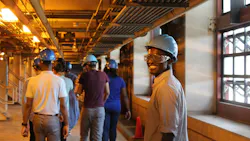
RISE — Regional Internship in Science & Engineering — has become a cornerstone of MMSD’s talent development efforts. Available to engineering students who attended high school or currently live in MMSD’s service area, it provides paid work experience and helps students build relationships with MMSD contractors such as planning and construction firms.
The program has been managed by consulting firm Prism Technical Management & Marketing Systems since it began in 2009.
“It really is about keeping talent in the area and working where they live,” said Keesha Jones-Sutton, Chief Strategy Officer at Prism and RISE Program Manager.
College students can participate starting their freshman year and return until they graduate. They’re given mentors, resume reviews and interview prep before participating in speed interviews to find their match for the summer.
“The biggest thing we teach them is networking is key,” Jones-Sutton said. “It’s going to carry you through your college years and as you become an adult.”
RISE students tend to find jobs quickly after they graduate, with many of them going on to work full-time with the companies for whom they interned.
Ali Yusuf is one of them. He joined RISE in 2015 after switching his major to civil engineering at UW-Milwaukee.
“It really opened the door for me,” he said. “They just literally put me in front of companies.”
After putting together his resume and going through about 10 interviews in one day, he listed the engineering firm GRAEF as his first choice. GRAEF, a contractor for MMSD, selected Yusef for an internship.
During his internship, which extended into summer 2016, he worked on a variety of municipal projects such as road construction, concrete testing and even repairing a sanitary sewer.
Yusuf had assumed he would move away from Milwaukee after college, but the RISE internship helped him see a future in the city. He started working for GRAEF after graduation and remains there seven years later.
“I don’t know if I would still be in the city or have landed the job that I did if it wasn’t for the RISE program,” he said. “That really helped me to see a future.”
Yusuf’s story is common for the program, Jones-Sutton said. Since 2009, RISE has supported 127 students, with 59% going on to secure employment in Wisconsin and 62% currently working in their field of study.
“What we hear from RISE students is it’s quicker for them to find a job because they’ve had this internship experience, and then the networking always comes into play because they know people in the industry who are actually working,” she said.
Community is Key
Although MMSD’s programs target different ages and offer different experiences, they have one thing in common: community partnerships.
“Our community partners are trusted messengers,” Coffaro said. “They help ensure people receive information in a way that is accessible, relevant and actionable, and they help connect individuals to the next step.”
He has heard the frustration families feel when they see job opportunities available in the water sector but don’t know how to access them.
“There is a workforce need — we need skilled workers entering the industry at the right time,” he said. “But we also believe opportunity should be accessible. People shouldn’t need insider connections to learn about these careers or understand how to get started.”
It’s a message that resonates across the political spectrum, he said.
“People may have different perspectives on many issues, but there is broad agreement that developing local talent and creating pathways to family-supporting careers benefits everyone.”
About the Author
 Stacy Vogel Davis
Stacy Vogel Davis
Stacy Vogel Davis is communications director for The Water Council.