Sealed for decades: A best-practice guide to pipe penetrations
Key Highlights
- Proper sealing of pipe penetrations prevents water and gas leaks, electrical interference, and structural shifts that can compromise facility integrity.
- Mechanical modular seals offer advantages like adjustability, reversibility, and vibration isolation over traditional grout or foam methods.
- Material selection should match environmental conditions; EPDM for water applications, nitrile for hydrocarbons, and silicone for high temperatures are recommended choices.
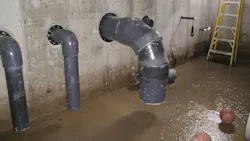
Every treatment plant, pump station, and valve pit has wall and floor penetrations where a carrier pipe crosses a structural boundary through a cored or cast opening. Left unsealed or backfilled with rigid, non-compressible grout, the penetration can become a weak point in the structure's water and gas barrier. The ground around it can shift over time, and if metal pipe touches the wall's rebar, it can create a stray electrical current that interferes with the plant's corrosion protection system. These details rarely appear on a Piping & Instrumentation Diagram and almost never surface in a design review, yet the seal at each penetration is part of the pressure boundary. Specifying and installing it correctly matters and can prevent costly remediation.
Why penetrations matter more than they look
Beyond the obvious air and water-tightness concern, an improperly sealed penetration creates three additional problems that tend to surface only after commissioning:
Vibration and noise transmission
Pipes carrying flow, especially near pumps, blowers, or valves, vibrate. If a pipe is rigidly grouted or wedged into a wall opening without isolation, vibration transmits directly into the structure, increasing wear at the penetration point and can create a noise problem.
Electrical continuity
Metallic pipes in direct contact with reinforcing steel or other buried metallic structures can create unintended electrical paths. Where cathodic protection systems are in place, an uninsulated penetration can compromise the entire protection scheme by providing a path for stray current to bypass it.
Chemical incompatibility
Not every elastomer suits every environment. A seal material selected for a clean-water application may degrade rapidly if the same penetration later carries a line exposed to hydrocarbons, fuels, or industrial solvents.
The case for mechanical, modular seals
Historically, engineers addressed pipe penetrations with cast-in-place grout, expanding foam, or modular rubber-and-steel assemblies - commonly referred to as mechanical pipe penetration seals. These modular seals wrap around the carrier pipe, fill the annular space with interlocking rubber links, and are compressed by pressure plates and bolts until they form a continuous, gas- and watertight barrier.
Three advantages of a modular mechanical seal over grout or foam:
- Adjustability: A single product line, sized correctly, can accommodate a range of annular gaps rather than requiring a custom pour for every opening.
- Reversibility: Unlike grout, a mechanical seal can be loosened, adjusted, or removed if a pipe needs to be serviced, moved or replaced.
- Vibration isolation: Because the pipe is cushioned by rubber rather than rigidly bonded to the structure, mechanical seals dampen vibration.
These seals appear in a wide range of environments, including municipal treatment plants, valve pits, precast concrete vaults, power generation facilities, marine bulkheads, and telecommunications vaults. Anywhere a pipe or conduit needs to cross a structural boundary without compromising its integrity, mechanical pipe penetration seals are recommended.
Material selection
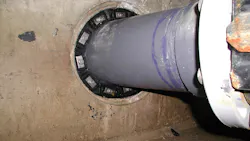
A common source of specification error is material selection. The standard elastomer for most water and wastewater applications is EPDM (ethylene propylene diene monomer), a synthetic rubber suited to a temperature range of roughly -40°F to 250°F. EPDM performs well in both above-ground and direct-burial conditions and provides electrical insulation where cathodic protection is a design requirement.
However, when a penetration might come into contact with hydrocarbons, such as oil, gas, jet fuel, or common solvents, EPDM is the wrong choice. Nitrile is the appropriate substitute in these conditions, offering comparable temperature performance with much better chemical resistance. For high-temperature applications, such as power generation or certain industrial process lines, silicone is rated to 400°F and extends the usable range considerably beyond that of standard elastomers.
Hardware selection is also important. Standard zinc-dichromate-coated steel bolts and pressure plates are adequate for most inland applications, but in coastal, marine, or highly corrosive environments, upgrading to 316 stainless steel hardware is warranted to avoid premature corrosion.
Installation
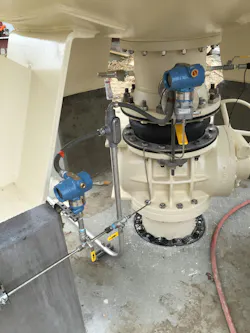
Mechanical pipe penetration seals are designed for a uniform annular space between the carrier pipe and the core opening. When the pipe runs centered through the opening, a standard seal fills that space. When the pipe sits offset or enters the opening at an angle, the gap varies around the circumference. Measure it at several points and compare the range against the size range of the seal under consideration. If a standard seal cannot absorb that variance, you can use a specialty assembly built from links of different sizes.
In either case, the seal closes the gap through modular pressure plates that compress the rubber links evenly around the pipe’s full circumference. Tightening bolts sequentially around the ring, rather than fully tightening one side before moving to the next, is essential for achieving uniform compression. Crews unfamiliar with this detail sometimes cross-tighten or work around the seal in a single pass, which can leave the rubber links unevenly compressed. This will likely result in a slow weep or minor leak that surfaces months later. If discovered during a wet season or a pressure test, the cause is harder to diagnose.
A practical installation sequence:
- Confirm the correct seal size against the actual pipe outside diameter and the wall opening's inside diameter. Under-sizing or over-sizing either dimension is the second most common field error after tightening technique.
- Wrap the seal around the pipe and connect the ends before inserting the assembly into the opening.
- Slide the assembled seal into position within the annular gap.
- Tighten each bolt incrementally, two to three turns at a time, moving sequentially around the pipe until pipe penetration seal is uniformly compressed and a proper seal is formed.
A small component with outsized consequences
For engineers and facility managers evaluating options, products like Proco's PEN-SEAL have a hydrostatic pressure rating of 20 psig, or roughly 40 feet of head pressure, and a temperature range suited to most water and wastewater conditions. All modular seals should come with installation and maintenance manuals that help ensure installation meets the product's specifications. Finding a local manufacturer with a reputation for quality, a solid inventory supply, and the ability to support installation and maintenance is extremely valuable for larger projects. But regardless of manufacturer, the underlying principles are the same: match the material to the environment, size the seal correctly, and install it with the same care given to any other pressure-retaining component in the system.
About the Author
 James M. Gannatal, P.E.
James M. Gannatal, P.E.
James M. Gannatal P.E., Mechanical Engineer with Proco Products, has over 15 years of experience in the elastomeric expansion joint and check valve industries. His experience involves product design and development, testing and implementation of elastomeric expansion joints and check valves.