Solving scarce water supply for sparse populations
Key Highlights
- The project replaces 60-year-old PVC pipes with high-density polyethylene (HDPE) pipes, significantly reducing water loss and extending system lifespan.
- Over 20 miles of HDPE pipe, rated at 200 psi, are being installed to improve water delivery from Vernon to Lockett, addressing high nitrate levels and environmental concerns.
- Industry partners like Performance Pipe, Dow, and Modern Dispersions contributed materials and expertise, showcasing a community-focused, collaborative approach.
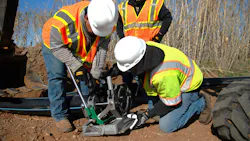
In Wilbarger county, Texas, a deserted, semiarid area of northwest Texas, reliable drinking water is a valuable, life-giving commodity. Making sure that 10,000 residents spread over 971 square miles get that water is the responsibility of the Red River Authority of Texas (Wichita Falls, TX). The utility has recently undertaken one major project that will see nearly 106,000 feet of new water pipe installed to bring water from Vernon, Texas to the outlying areas of Lockett, Texas. This will replace the old pipeline which lost 43 percent of the nearly 100,000 gallons of water pumped each day. Extreme water loss is common in the state. Estimates peg the general loss of water in Texas at 30 billion gallons annually from fractured and leaking pipes. The American Society of Civil Engineers’ (ASCE) 2025 Infrastructure Report Card gave Texas’ drinking water system a D+.
“In this area, we have 315 connections, serving about 1,000 customers,” explained Fabian Heaney, Red River Authority’s General Manager. “We’ve had many years of experiencing water loss in the area due to the six-inch PVC pipe that is more than 60 years old and has reached the end of its useful life. So, we’re replacing it with high-density polyethylene (HDPE) pipe to get a much longer life than we actually would with PVC or C900.” Additionally, the new system will be compliant with the Texas Commission on Environmental Quality (TCEQ ) water delivery requirements.

HDPE pipe has been used in municipal water applications for more than 50 years. Heat-fused joints create a leak-free, self-restrained, monolithic piping system that also eliminate infiltration into the pipe and exfiltration into the environment. HDPE pipe has other benefits which include resistance to water hammer, fatigue, ground movements, freezing temperatures, earthquakes, corrosion and tuberculation.
More than 20 miles of the HDPE PE4710 pipe in four- and six-inch diameters is being used to bring water from the City of Vernon to Red River’s customers in and around Lockett. This is due to the high nitrate level found in the area’s wells that formerly provided the water supply. For this project, Red River called on the Plastics Pipe Institute for assistance.
“This is really an economically challenged area that was in dire need of a replacement for a water line,” offered David M. Fink, president, Plastics Pipe Institute, Inc. (PPI). “And we had several members — Performance Pipe, Dow and Modern Dispersions — step up and were willing to contribute raw materials, pipe, installation guidance, training, et cetera. This was a wonderful opportunity to help the community.”
PPI, founded in 1950, is the major North American trade association representing the plastic pipe industry. With more than 300 members, it is a resource for data, technical information and engineering assistance.
Fink continued, “The Plastics Pipe Institute excels as a one stop shop for everything from technical expertise to guidelines, revision of standards and codes, and anything that is really needed to have a successful HDPE pipe infrastructure project. We brought all this to bear for the Red River Authority on this project.
Performance Pipe, a division of Chevron Phillps Chemical Company, supplied five miles of its Driscoplex four-inch DR-11 HDPE pipe in 800-foot lengths, and 15 miles of six-inch DR-11 HDPE pipe in 500-foot lengths. Both are rated at 200 psi.
“As a member of the Plastics Pipe Institute, we were informed that there's a community in Lockett, Texas that was in need of water pipe,” stated Jonas Abraha, manufacturing manager, Performance Pipe. “We’ve been in this business for more than 60 years. When you think about this opportunity, the pipe was converted into polyethylene pellets by Texans, and then later converted into a polyethylene pipe by Texans for Texans. As a longtime member of PPI, we’re very proud of being part of this project.”
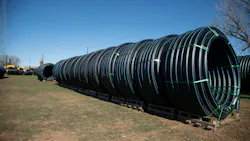
According PPI, the resin used to make the pipe, PE4710, is the highest performance classification of HDPE piping material for water applications. "PE4710 HDPE pipe is tough, durable and flexible, meeting AWWA C906-21 and ASTM F714 standards," stated Camille George Rubeiz, P. E., F. ASCE, director of engineering for the Municipal and Industrial Division of PPI, and co-chair of the HDPE Municipal Advisory Board.
"PE4710 compounds offer an excellent level of performance. This means PE4710 HDPE pipe can be used with increased flow capacities, plus it has increased resistance to surge pressure, fatigue and slow crack growth. The ANSI/AWWA C906-21 standard includes PE 4710 for sizes up to 65 inches and recognizes the increased durability and reliability of HDPE pressure pipe used in water systems."
Dow’s CONTINUUM Bimodal Polyethylene Resin was used to make the pipe. “The bimodal HDPE material donated by Dow exceeds industry performance standards and offers increased reliability,” explained Dell Doyle Ph.D., TS&D scientist at Dow, who also serves on several of PPI committees and whose family is from the area. “Pipes manufactured using our resins offer excellent resistance to chlorinated water and slow crack growth with the highest chlorine resistance (CC3) rating required in AWWA C906-21. Dow’s PE4710 bimodal resins are an excellent material for reliable extrusion and construction installation.”
Another PPI member company, Modern Dispersions, Inc. (Leominster, MA), provided the carbon black, a key ingredient that is added to the resin.
“This pigment also acts as a UV stabilizer to protect the pipe from weathering, explained Rene Collin, strategic accounts manager for the company. “Without it, the projected 100-year use life of the pipe wouldn’t be possible. Our black masterbatch grade MDI PE-535-0092 is approved for use with the PE4710 HDPE pressure pipe.”
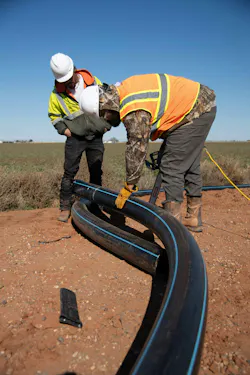
The goal was not only to build a fresh water supply line, it was also meant to keep water from being wasted due to pipe sections coming apart. The pipe selection was especially important because of soil conditions. Plus, the area has the second highest risk for earthquakes and seismic events in Texas. The most recent earthquake to hit the Texas panhandle had a magnitude of 2.8 in February 2025.
“The seismic shifts, soil conditions and the desert-like environment can impact pipe,” Rubeiz continued. “This includes aftershocks that can continue for years from an earthquake. As with all installations, and especially in this area of Texas that has had seven earthquakes during the past 12 months, it is important to have the proper wall thickness for an HDPE water system in a seismically sensitive area, subjected to an induced lateral spread.”
A Municipal Advisory Board (MAB) of PPI technical document provides data and formulas for determining the proper wall thickness for a fused, highly ductile, flexible HDPE water main in a seismically sensitive area. MAB-9, Design of HDPE Water Mains for the Lateral Spread Seismic Hazard is available for free on the group’s website.
In 2022, Heaney and his crew repaired damage from another natural disaster in northwest Texas. In February of that year, a winter storm brought record setting cold temperatures, fracturing the town of Carey Northfield’s14-inch cast iron water supply line. It was replaced with 34,000 feet of four-inch HDPE pipe.
“We find with HDPE, it's a superior product,” stated Heaney. “It's more efficient and economical to install per mile, and it has a longevity that will really pay dividends in the long run for the Authority and for our customers.
“The Red River Authority of Texas would really like to thank PPI, Dow, Performance Pipe, and Modern Dispersions for their donations and their time in getting this project completed.”
About the Author
Steve Cooper
Steve Cooper has reported on numerous infrastructure projects for several decades. Based in New York, he has traveled extensively to conduct on-site news interviews with professional engineers, contractors, government officials and representatives of major companies supplying the industry. He can be reached at [email protected].