If you’ve been following the Colorado River lately, you know the story keeps getting bigger. On October 16, Arizona announced it was joining Nevada’s lawsuit against the federal government over how the river will be managed. Nevada filed in August, challenging the Department of the Interior’s plan.
The question underneath it all is a big one: should the Lower Basin states absorb major cuts while the Upper Basin isn’t required to make comparable reductions? The federal government says its framework gives it the flexibility to manage critically low reservoirs and keep negotiations going. Arizona says alternatives asking more of the Upper Basin weren’t adequately considered. And the numbers are hard to wrap your head around. In the scenario being challenged, Arizona could lose up to 760,000 acre-feet a year, California 440,000 and Nevada 50,000. That adds up to roughly 407.5 billion gallons of water annually.
What I keep coming back to is how this plays out for those of you who plan around water for a living. Utilities, farmers and cities make decisions years, even decades, ahead. The current framework runs through 2036, but the operating guidelines are generally expected to be revisited every two years. A flexible plan makes sense for a river with unreliable flows. But flexibility only helps when you can plan around it.
It also sent me back to 1922. The Colorado River Compact was built on flow estimates that included unusually wet years, so the states divided up water on paper that the river can’t reliably deliver. When there’s enough water, an allocation looks like a fair compromise. When there isn’t, the same allocation becomes a debate over who absorbs the shortfall, and “what’s fair?” turns out to mean different things depending on what you measure.
On a recent episode of Talking Under Water, we walk through this news and some of the interesting historical context behind it. Give it a listen or read it here to link out to helpful maps, and we’ll keep following the lawsuit and the negotiations together.
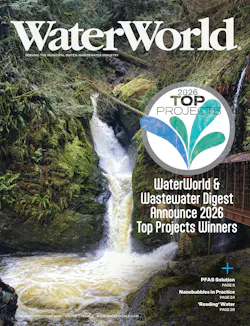
Read the November December digital issue.
Cover Feature | 18
Top Projects
From treatment plant expansions and rehabilitation to digital twins and automated stream diversion, this year’s Top Projects feature showcases five drinking water and five wastewater projects tackling infrastructure, efficiency, and reliability.
8 Beyond Separation: Exploring the Next Generation of PFAS Solutions
As PFAS regulations continue to evolve, utilities and other stakeholders are increasingly being challenged to evaluate treatment and management approaches across the full water cycle rather than within individual programs or assets. Read about evapotranspiration.
12 Sealed for Decades: A Best Practice Guide to Pipe Penetrations
Properly sealed pipe penetrations protect treatment plant integrity. Learn how material selection, mechanical seals and correct installation help prevent leaks, isolate vibration and avoid costly repairs over the long term.
16 Flowing Forward: Applied Research, Workforce Training, and Community Outreach at The Water Tower
Through the development of training programs, extensive research efforts, and collaboration with community partners, The Water Tower is helping translate emerging needs into practical solutions and keep the water sector flowing forward.
Wastewater Digest Features
24 Nanobubbles in Practice
The technology itself is proven; the question for utilities is no longer whether nanobubbles work, but where they can create measurable operational value.
26 Q&A: Innovations and Challenges in Water Infrastructure
As the year comes to a close, Garney Construction illuminates the lastest trends, issues and opportunities for water utilities in the marketplace from a contractor’s perspective with Andy Hawthorne, regional operations manager and Patrick Vidonish, DBIA, director - plant central.
Stormwater Solutions Feature
28 Read the Water: Inspecting Stormwater Systems After Major Rainfall
Major rainfall puts stormwater infrastructure to the test. Learn how post-storm inspections of ponds, inlets, outfalls and drainage channels can reveal early warning signs, prevent costly failures and guide long-term maintenance.
About the Author
 Mandy Crispin
Head of Content
Mandy Crispin is the editor-in-chief of WaterWorld magazine and co-host of water industry podcast Talking Under Water. She can be reached at [email protected].